
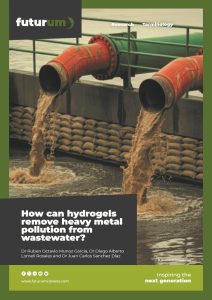
How can hydrogels remove heavy metal pollution from wastewater?
Industrial processes often generate wastewater that is contaminated with pollutants such as heavy metals and toxic chemicals. Before this water can be released into the surrounding environment, it must be treated to remove these harmful substances. At Universidad de Guadalajara in Mexico, Dr Ruben Octavio Munoz Garcia, Dr Diego Alberto Lomeli Rosales and Dr Juan Carlos Sanchez Díaz are developing innovative hydrogels that can remove toxic heavy metals from wastewater.
Talk like an environmental chemist
Adsorption – when molecules from a gas or liquid stick to the outer surface of a material
Carboxylate group – a negatively charged chemical group (formed when a carboxylic acid group loses a hydrogen ion) that can attract and bind positively charged heavy metal ions
Heavy metal – a metallic element with a relatively high atomic weight and density that can be toxic to living organisms and pollute the environment
Hydroxypropylcellulose – a modified form of cellulose used to improve stability
Ion – an atom or molecule that has an electrical charge because it has lost or gained electrons
Polymer – a long, chain-like molecule made from thousands of smaller molecules
Sodium hydroxide – a highly corrosive powder used in many cleaning products
Solvent – a liquid that dissolves another substance to form a solution
Wastewater – a byproduct generated by many industrial processes that often contains pollutants
Reference
https://doi.org/10.33424/FUTURUM726


All over the world, our waters are being polluted by toxic heavy metals that pose a threat both to aquatic ecosystems and human health. Many industries, such as chemical manufacturing and textile production, release wastewater into their surrounding environments and local sewage systems. Although there are regulations designed to prevent this pollution, many factories and manufacturing plants still release untreated wastewater that is full of heavy metals.
“This wastewater can pollute soil and groundwater and contaminate rivers and lakes,” says Dr Ruben Octavio Munoz Garcia from Universidad de Guadalajara. “In some cases, heavy metals have even been found in fish.” Drinking contaminated water and eating contaminated fish can cause serious health problems, including kidney and blood diseases.
Alongside his colleagues Dr Diego Alberto Lomeli Rosales and Dr Juan Carlos Sanchez Díaz, Ruben is improving a technique for removing heavy metals from contaminated wastewater.
How to treat industrial wastewater
“Current methods for treating industrial wastewater are often expensive, generate secondary waste and require large amounts of energy or chemicals,” says Diego. “Many of these methods are also not particularly effective at removing low concentrations of heavy metals.”
To overcome these limitations, Ruben, Diego and Juan are developing a new wastewater treatment technique based on hydrogels – three-dimensional networks of polymers that can hold large amounts of water while maintaining their structural integrity. “To remove heavy metals from wastewater, hydrogels are placed in a solution containing heavy metal ions,” explains Juan. “After a short period of time, the swollen hydrogel is taken out of the solution, removing the adsorbed heavy metals from the water.”
How hydrogels work
“The ability of hydrogels to adsorb heavy metal ions depends on the number of active binding sites,” explains Ruben. “Increasing the number of these binding sites enhances the adsorption potential of the hydrogel.” Another way to make hydrogels more effective is to improve their structural integrity. This can be done by a process known as crosslinking.
“Crosslinking is the chemical process in which two or more polymer chains are bonded together,” explains Diego. “The structural integrity of the hydrogel is provided by the three-dimensional polymer network formed through crosslinking.” Without crosslinking, the polymer chains would simply dissolve in the water. By bonding the polymers together, they form interconnected networks that swell in water rather than dissolving.
The amount of crosslinking in a hydrogel determines how stable it is and how much water it can adsorb. A hydrogel with lots of crosslinking will be structurally stable but able to hold less water. On the other hand, a hydrogel with less crosslinking will be able to hold much more water, but is more likely to deform and release the captured water. Ruben, Diego and Juan are investigating new methods for creating hydrogels that can adsorb large amounts of water while maintaining their structural integrity.
How to make hydrogels more effective
“We incorporated cellulose into our hydrogels to improve their structural stability during the adsorption process,” says Juan. “It acts as a reinforcing component, helping the hydrogel retain its shape during adsorption.” Cellulose is the structural component of plant cell walls and is the most abundant natural polymer in the world, making it an affordable and sustainable material.
Cellulose has a highly organised molecular structure and tight internal hydrogen bonds, making it incredibly tough and durable. However, this toughness also means that it cannot dissolve in water or organic solvents, making it difficult to incorporate into hydrogels. To overcome this problem, Ruben, Diego and Juan used a modified form of cellulose called hydroxypropylcellulose in their hydrogels.
Turning cellulose into hydroxypropylcellulose involves breaking just enough of its hydrogen bonds to make it soluble in water and solvents while maintaining some of its structural integrity. This solubility allows it to easily graft onto the polymer chains that make up a hydrogel, transferring its structural strength to the hydrogel. Hydroxypropylcellulose allows the hydrogel to maintain its structure in industrial treatment pumps where there is high water pressure and rapid flow.
How a hydrogel captures heavy metals
Ruben, Diego and Juan used a polymerised form of acrylic acid as the backbone of their hydrogel. “We converted the carboxylic acid groups on these polymers into negatively charged carboxylate groups by treating them with sodium hydroxide solutions,” explains Ruben. “These carboxylate groups act like tiny molecular claws, surrounding and tightly holding heavy metal ions.”
The combination of carboxylate traps and hydroxypropylcellulose reinforcement made the team’s hydrogel particularly efficient. “In our lab, we performed adsorption tests on our hydrogel in a solution containing nickel ions,” says Diego. “Our hydrogel decontaminated the green nickel solution after a quick adsorption process, turning green itself in the process.” The hydrogel adsorbed up to 80% of the nickel ions present in the solution, showing how effectively it can remove heavy metals from water.
Ruben, Diego and Juan hope that their innovative hydrogels will allow industries to clean their wastewater more effectively and at a lower cost, protecting surrounding environments, local wildlife and nearby communities.
 Dr Ruben Octavio Munoz Garcia
Associate Professor, Department of Chemistry
Dr Diego Alberto Lomeli Rosales
Associate Professor, Department of Chemistry
Dr Juan Carlos Sanchez Díaz
Professor, Department of Chemical Engineering
Fields of research: Chemistry; hydrogels
Research paper: A Poly(Acrylic Acid)-Based Hydrogel Crosslinked with Hydroxypropylcellulose as a Clarifying Agent in Nickel(II) Solutions. (2025) doi: 10.3390/gels11070560
Funder: Universidad de Guadalajara (PROSNII-2026)
Do you have a question for Ruben, Diego or Juan?
Write it in the comments box below and they will get back to you. (Remember, researchers are very busy people, so you may have to wait a few days.)

Learn about how pollutants can affect aquatic ecosystems:
futurumcareers.com/how-do-organic-micropollutants-affect-fish
0 Comments