
Our aim is to champion young people
In the current uncertain economic climate, many young people are struggling to find employment. Baz Ramaiah, Director of Policy and Research at Youth Employment UK, tells us about the challenges young people are facing and the support the organisation is providing to ensure all young people can access and thrive in the world of work.
 What is Youth Employment UK’s mission?
Youth Employment UK is the UK’s national body for youth employment. Our social mission is to ensure all young people, no matter their background, can access and thrive in the world of work. This also means ensuring they have access to the necessary education and training to prepare them for employment.
How do you achieve your mission?
We work with young people, employers and the government to understand what barriers young people face and develop solutions to overcome them. For young people, we provide a wealth of resources and support to help them identify and access training and employment opportunities. We work with employers to help them become more youth-friendly – both in terms of how they create employment and training opportunities for young people, and then how they support young people once they are in work. We also do a lot of research and policy work, which I lead. We conduct research by surveying young people and employers and analysing government policies. A key part of this research comes through our annual Youth Voice Census. The aim is to provide the evidence to advocate for system-wide policy change, ensuring that future policies have young people at their heart.
What is the Youth Voice Census?
Our Youth Voice Census is the largest annual survey of young people in the country. It captures their experiences of and attitudes towards education and employment. We also ask their opinions about their local area, as this has a massive influence in shaping the education and employment opportunities they have access to.
The 2026 Youth Voice Census is currently open and closes on 14th June. Share your voice at: youthemployment.org.uk/youth-voice-census
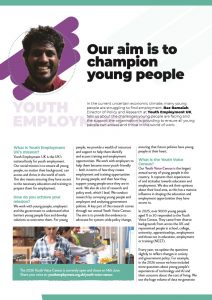

Youth Employment UK helps young people find employment and training opportunities and runs the annual Youth Voice Census to capture young people’s opinions about education and employment.

In 2025, over 9000 young people aged 11 to 30 responded to the Youth Voice Census. They came from diverse backgrounds from across the UK and represented people in school, college, university, apprenticeships, employment and those not in education, employment or training (NEET).
Every year, we update the questions slightly to reflect changes in society and government policy. For example, in the 2026 census we have included more questions about young people’s experiences of technology and AI and their concerns about the cost of living. We use the huge volume of data we generate from the census to amplify young people’s voices in policy conversations.
Why is work experience so important for young people?
In the 2025 census, over 50% of young people reported that their main barrier to getting into work was a lack of work experience. And the employers we work with also highlight that a candidate’s lack of experience is their main barrier to hiring young people.
Our research has shown that work experience opportunities are crucial for getting young people into employment, as well as allowing them to gain an understanding of what the world of work looks like and helping them figure out what they want to do.
However, access to work experience is shrinking. Last year, only 26% of surveyed young people in education took part in work experience. As employers feel the financial pinch, they find it harder to create capacity to take on young people for work experience. To try and address this, we support employers to make the most out of resources that will help them create work experience opportunities for young people.
Access to careers advice is also decreasing, with only 30% of secondary students receiving careers lessons and only 23% meeting employers through school. Careers education, work experience and employer engagement are the bridges into work, but each is in decline. Students who are Black, receive free school meals or have additional needs, along with NEET young people, are consistently the least supported, leaving the young people who most need opportunity with the least access to it.
What challenges do young people face when looking for employment?
Young people from disadvantaged backgrounds are more likely to experience physical and mental health issues and are less likely to have high-quality services in their local area to provide health support, financial support or access to work.
These issues can compound in any given individual, especially in the uncertain economic climate of today. NEET young people often sit at the intersection of complex individual factors, where family circumstances, physical and mental health issues, educational experiences, and availability of opportunities and support in their local area all create challenges to accessing work and training.
When young people are not in education, employment or training, this is usually not for a lack of trying. Many NEET people reported engaging in dozens of different routes towards finding a job in the previous 12 months, but without success.
In addition to the difficult job market, mental health adds another challenge, with 30% of NEET people reporting that anxiety is one of their biggest barriers to applying for and securing a job. For young people who experience anxiety, the process of applying for a job can make them feel more anxious. And this anxiety can increase if they apply for a job and never hear back from the company.
The current economic climate means that the number of job vacancies is down 15% compared to the same time last year, and the number of redundancies is up 10%. This means the total number of job opportunities is shrinking while the number of people looking for work is growing, leading to a more competitive job market. This also means young people with less experience are having to compete with more experienced workers who are looking for new roles.
There is a lot of economic precarity for young people at the moment, which increases their stress and anxiety about being out of work. Almost every year in the census data, one in five young people report that making ends meet is a significant concern for them. And this adds to the pressure of finding work in a competitive market.
This is why interventions and programmes such as the government’s national Youth Guarantee are really important for increasing opportunities for young people and reducing competition with more experienced people in the job market, thereby making work more accessible for young people.
How has Youth Employment UK contributed to the Youth Guarantee?
We work closely with a lot of people in government, and the government has recognised that there has been a failure to incentivise employers to offer more employment and training opportunities to young people. Thanks to our work and the evidence we have provided through our research, the government has now adopted the national Youth Guarantee which provides funding to employers to create work experience opportunities for young people as well as youth hubs for young people to access local support and youth job programmes.
Now, our concern is to make sure the Youth Guarantee is delivered effectively in a way that builds on the evidence of impact that we have provided from our surveys and research. We will monitor the programmes over the coming years to ensure they are iteratively improved and are successful at achieving their aims.
What other policies is Youth Employment UK supporting?
We made various policy recommendations after the 2024 census, and we’re delighted to see that many of them have been taken up by local and national governments and employers! In addition to rolling out the Youth Guarantee, we want to ensure there is a sustainable funding mechanism behind it to support the employers who are providing opportunities for young people. Underneath and supporting that, we want to ensure there is a strong social safety net for young people, in terms of access to public transport, housing and mental health support, which could help to eliminate a lot of the barriers that many people face to accessing education, employment and training opportunities.
What else does Youth Employment UK do?
Our aim is to champion young people by sharing their voices. Young people want to work; they just need opportunities to do so. So, we are supporting campaigns to highlight the benefits young people can bring to employers.
We have so much on our website! We’ve been working with young people and employers for years and have built up a huge range of resources, all of which are free to access. Our ‘opportunity finder’ is a one-stop-shop where young people can search for training and employment opportunities in their local area. We provide free skills training courses, along with careers guides, advice about writing CVs and tips about how to manage mental health with directions for where to look for professional support. We also provide careers advice for parents and carers as well as careers lesson plans for teachers.
We have so much to share with young people to support them through education and training and into employment.
 facebook.com/YouthEmploymentUK
 linkedin.com/company/youth-employment-uk/

Do you have a question for Baz?
Find careers advice from the University of London Careers Service:
www.futurumcareers.com/find-where-you-thrive
0 Comments