
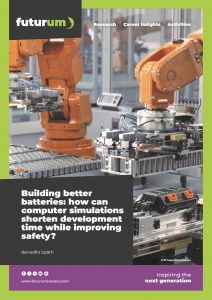
Building better batteries: how can computer simulations shorten development time while improving safety?
As the global shift to renewable energy accelerates, so does our need for batteries, both for personal use and in industry. Batteries need to store more energy than ever before, at lower costs, while also being sustainable and safe. At RWTH Aachen University in Germany, Benedikt Späth is using computer simulations to supercharge the process of developing new batteries.
Talk like a production engineer
Cell – the components in a battery that convert chemical energy into electrical energy
Computer simulation – a digital model that imitates how something works or behaves in real life, so it can be tested without building a physical prototype
Digital toolchain – a set of connected software tools that share data and are used in combination with each other to help design, build and test a product from start to finish
Iterative – a process of repeating a cycle of operations, such as designing and testing, to improve a product more and more each time
Model-based systems engineering (MBSE) – a methodology which uses models to represent and test how different parts of a system work together
Production engineering – the branch of engineering focused on designing and improving how products are manufactured efficiently and at large scale
Thermal runaway – a dangerous situation where a battery overheats uncontrollably because it keeps generating more heat than it can release
Since waking up this morning, you have probably used multiple products powered by batteries. These essential electrical powerhouses are found in mobile phones, laptops, cars and other everyday devices.
“Society’s demand for batteries has grown significantly, driven by the global transition towards electrification and decarbonisation,” says Benedikt Späth, a production engineer at RWTH Aachen University. “As we move away from fossil fuels and towards renewable energy and electric technologies, batteries have become a key enabling technology for storing and using energy efficiently.”
Demand, design and development
Private use of batteries is soaring, as individuals move to using electric vehicles, solar panels and home energy storage systems. Renewable energy sources are increasingly used in industry, but solar and wind are weather-dependent and so rely on batteries to store energy when it is available and release it when it is needed.
This demand for long-lasting, large-scale and cost-effective batteries presents significant challenges for battery developers. “Improving one property often comes at the expense of another: for example, higher energy density can reduce safety,” says Benedikt. “In addition, developers face challenges related to raw material availability, sustainability and recycling, while also scaling up production.”
Battery development involves several stages, from initial design and material selection to testing and large-scale production, with simulations and experiments working together to improve performance and safety throughout. “Physical battery cells are built and tested, meaning simulations can be validated with real data,” says Benedikt. “This is an iterative development cycle, where insights from testing continuously feed back into earlier design stages.”
Powering forward with computer simulations
It can take many years to develop a new battery product, so Benedikt is using computer simulations to help to speed things up by moving test experiments into the digital world. “This means new battery technologies can reach the market more quickly, helping to reduce costs, improve sustainability and accelerate the transition to renewable electric systems,” he says.
Reference
https://doi.org/10.33424/FUTURUM701
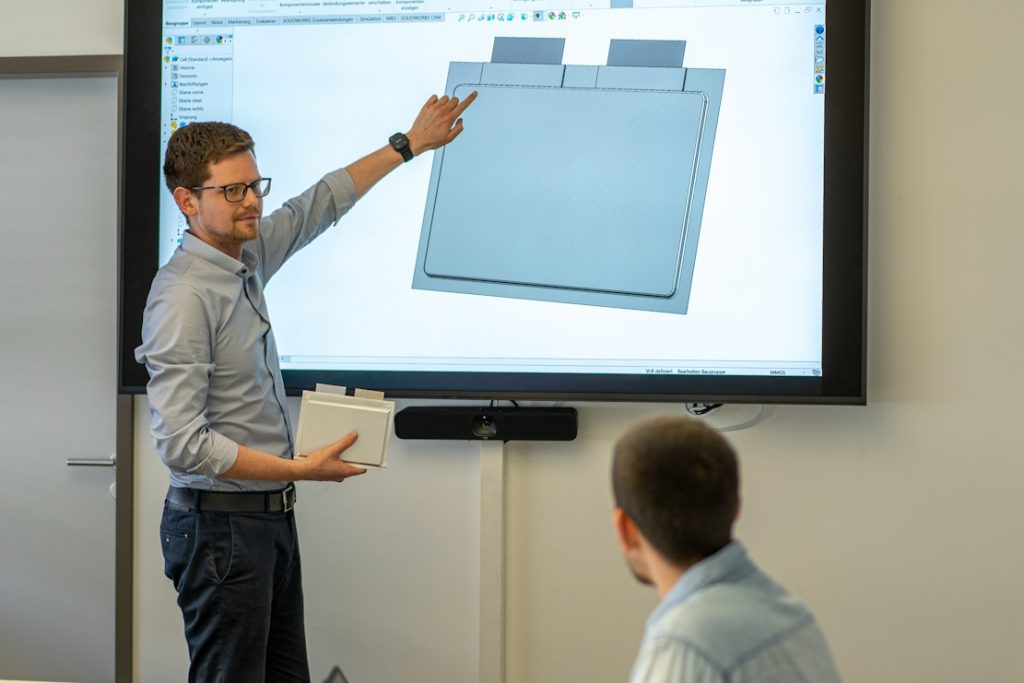
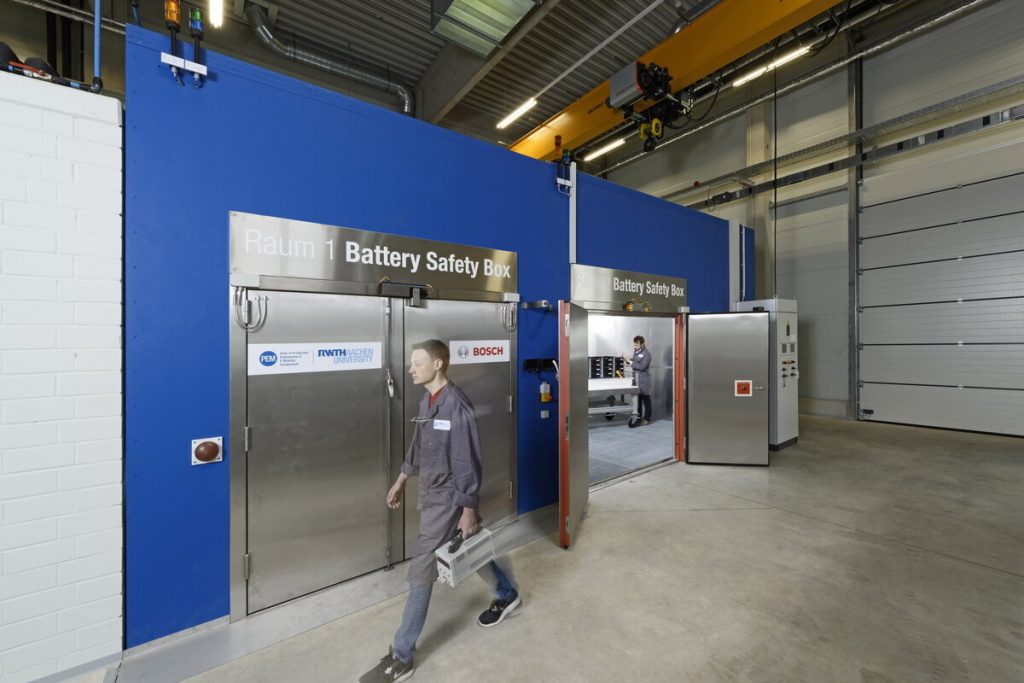


Benedikt uses digital toolchains which link design, testing and data analysis tools so information flows smoothly and automatically from design to production. “This increases transparency and reduces inefficiencies,” he explains.
Using digital toolchains also avoids the time delays caused by treating product development and production separately and allows Benedikt to constantly link the two by running simulations of both, which feed off each other. “We analyse how design decisions affect production and vice versa,” he says. “We can detect issues much earlier which reduces costly redesign loops. On the product side, we simulate the behaviour of battery cells to predict performance, lifetime and safety. On the production side, we simulate manufacturing steps to understand how process parameters influence the final cell properties.” These simulations rely on a combination of physics-based and data-driven models, integrated into a digital workflow that evolves as more data becomes available.
Thermal runaway
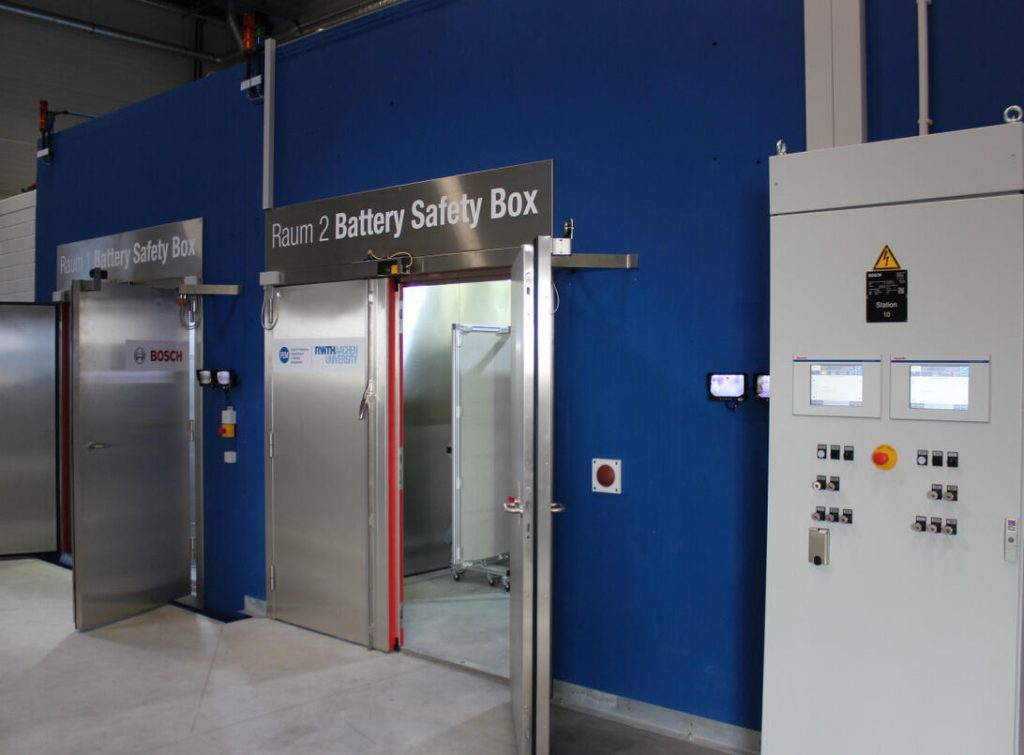
One of the key concerns for battery safety is thermal runaway. “This is a self-reinforcing overheating process inside a battery,” explains Benedikt. “Once it starts, the battery generates heat faster than it can dissipate it, causing the temperature to rise rapidly in an uncontrolled way.”
Thermal runaway can be caused by internal issues within the battery or by external issues such as damage or overheating, leading to explosions, fire and the release of toxic or flammable gases. Fortunately, incidents are few and far between, thanks to the inclusion of advanced safety features in today’s batteries.
“We conduct thermal simulations which calculate how heat is generated and distributed inside a battery cell under different operating conditions, such as current, voltage, charging rates and material properties,” says Benedikt. These models are part of a model-based systems engineering (MBSE) approach, linking thermal, electrical and mechanical behaviour to provide a complete picture. Early models are simple and fast while later models build complexity, and all models are validated with real data. “This allows us to evaluate safety-relevant scenarios early, reducing the risk of costly and dangerous failures.”
The results are useful and practical. Benedikt’s simulations reveal temperature patterns within the cell and battery system, identify hot spots and highlight cooling requirements. “We can understand where a battery might overheat and potentially enter dangerous states such as thermal runaway,” says Benedikt. “We can identify critical conditions before they occur in reality.” This helps product engineers make informed design choices about cell layout, cooling systems and safe operating limits early on in development.
Benedikt highlights that simulations do not replace real-world testing. Instead, the two approaches work together, each informing the other. “Simulations reduce the need for physical prototypes and enable faster and more efficient development, but in the end, simulations are always validated with real tests,” he says. “For example, in thermal runaway investigations, we deliberately push batteries to their limits – through overcharging, heating or mechanical damage. In some cases, this can lead to severe failure events, including fire or explosions.”
Computer simulations play a vital role in making the transition to renewable energy happen quickly, smoothly and safely, and the focus on safety is essential. “Batteries store a large amount of energy in a small space and are used in everyday applications such as electric vehicles and home energy storage systems,” says Benedikt. “Reliable and safe batteries are therefore crucial for building trust in new technologies and enabling the transition to sustainable energy systems.”

Benedikt Späth
Head of Battery Development, Chair of Production Engineering of E-Mobility Components, RWTH Aachen University, Germany
Field of research: Product development; production engineering
Research project: Using computer simulations to improve battery development processes
Funder: The Na.Ion.NRW Project (EFRE-20800353) is funded by North Rhine-Westphalia and the European Union
About production engineering
Would you like to work in an exciting and varied field, where you get to take innovative ideas and turn them into high-quality mass-produced products that solve some of the key problems of our time? If so, production engineering may be for you.
“Production engineers work at the intersection of engineering, data and business,” says Benedikt. “They apply digital tools such as simulation, automation and artificial intelligence to improve production systems. Production engineering has a direct and visible impact on the real world. You are not only designing ideas – you are helping to turn them into products that people use every day.”
Benedikt specialises in battery development. “Engineering in the battery field is particularly exciting because it is a highly dynamic and future-oriented field,” he says. “Battery technologies and production methods are evolving rapidly, which means there are always new challenges to solve and opportunities to innovate.”
Future production engineers will be at the forefront of providing vital solutions to global challenges, such as improving the sustainability of product design and production processes, producing new technologies at scale without compromising on quality or safety, and advancing the field alongside advances in data, technology and artificial intelligence. “Future production engineers will not only optimise factories but also help shape the transition to a more sustainable, electrified and digital society,” says Benedikt. “Whether you’re working on climate change, sustainable energy or electric mobility, many solutions depend on the ability to develop and manufacture new technologies efficiently and at scale.”
Pathway from school to production engineering
“At school, subjects such as mathematics and physics are especially important, as they help develop analytical thinking and an understanding of how technical systems work,” says Benedikt. “Computer science is also becoming increasingly valuable, as digital tools and data play a major role in modern engineering.”
At college or university, typical study paths include mechanical engineering, industrial engineering or product design, which provide a broad understanding of both technical systems and production processes. During your studies, you can specialise in areas such as production engineering, manufacturing technologies or industrial digitalisation.
“In addition, skills in programming, data analysis and simulation are becoming more and more important, especially in fields like battery production, where digital tools are used to optimise both product design and manufacturing processes,” says Benedikt.
Explore careers in production engineering
Everything that is manufactured requires production engineers to help develop the production process, so the career opportunities are endless!
Benedikt recommends exploring university websites and professional engineering organisations to learn about career paths, research and opportunities. For example, you can learn more about Benedikt’s research in the Chair of Production Engineering of E-Mobility Components at RWTH Aachen University: www.pem.rwth-aachen.de
“My main advice is to stay curious and hands-on,” says Benedikt. “Try to understand how things are made and don’t be afraid to explore technical topics in practice by building things yourself or using tools like 3D printing.”
Meet Benedikt
My grandfather sparked my fascination with technology. He was someone who could repair almost anything and had a deep practical understanding of how things work. He gave me my first computer, taught me how to use tools and encouraged me to explore technology on my own.
As a teenager, I enjoyed taking things apart, understanding their functionality and thinking about how they could be improved. I was also involved with the fire brigade and rescue services, where I experienced responsibility in real-world situations and gained early exposure to technical systems in practice.
I was motivated to pursue engineering by the idea of turning concepts into real products that have an impact. It is very satisfying to contribute to technologies, such as batteries, that play an important role in areas like electric mobility and renewable energy.
Batteries are everywhere in our daily lives. From smartphones and laptops to electric vehicles and renewable energy systems, we rely on batteries almost constantly, often without even noticing it. At the same time, each battery cell is a highly complex system where small changes can have a huge impact on performance, safety and lifetime.
In my free time, I enjoy spending time in nature, especially through activities like hiking, biking and diving. These help me stay active and provide a good balance to my daily work.
Benedikt’s top tip
Don’t be afraid of challenges. Engineering problems can be complex, but that is exactly what makes them interesting. Learning how to approach and solve problems step by step is more important than having immediate answers.
Meet Achim
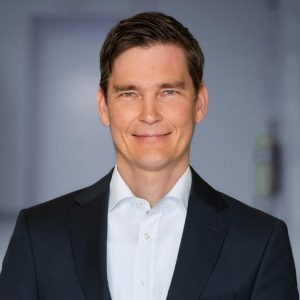 Professor Achim Kampker is a mechanical engineer and the chair-holder of Production Engineering of E-Mobility Components at RWTH Aachen University.
As a teenager, I was very interested in agriculture and wanted to become a farmer. I was fascinated by working with nature, creating something tangible, and understanding systems that must function sustainably over long periods of time.
Becoming an engineer was not a childhood dream – it was more a process of elimination. Other options didn’t feel like the right fit and engineering remained. Looking back, it turned out to be the right choice.
Being a mechanical engineer is rewarding because I can truly make an impact by creating technologies, systems and ideas that will change industries or improve society. However, it can be frustrating to deal with the slow pace of processes, especially when innovation could move much faster.
I find the efficiency and enormous potential of batteries fascinating. They are not just storage devices; they are key enablers for the energy transition, electrification, and entirely new mobility and industrial systems.
When I’m not working, I value spending time with my family which gives me balance, energy and perspective.
Achim’s top tip
Be persistent, work hard and stay curious. Opportunities are often not obvious at first – you need to recognise them and be willing to take them when they appear.
Do you have a question for Benedikt?
Write it in the comments box below and he will get back to you. (Remember, researchers are very busy people, so you may have to wait a few days.)
Discover how other engineering fields are contributing to the green energy transition:
futurumcareers.com/how-can-electronics-engineers-help-to-power-the-green-transition
0 Comments