
A taxonomy of discrimination: how can a new framework help protect our human rights?
Every human on Earth has the right to equal treatment regardless of race, gender, religion or any other protected characteristic. Despite this human right, discrimination is widespread and causes serious harm to people all around the world. At Newcastle University, PhD candidate Bernardo de Mello has developed a taxonomy of discrimination to help human rights courts make more informed rulings in cases of discrimination.
Talk like a human rights law researcher
Cultural violence — ideas, beliefs, symbols and narratives that make direct or structural violence appear normal, acceptable or unavoidable
Direct violence — physical attacks, killings, threats and other harms with an identifiable actor and victim
Discrimination — the unfair treatment of a person or group based on traits such as race, gender or age
Intersectionality — a concept describing how social identities overlap to create unique combinations of discrimination
Structural violence — when an institution systematically prevents a group of people from accessing their basic needs and rights
Taxonomy — a system for organising different types of something
Everyone is entitled to human rights. They apply to all of us, no matter who we are or where we come from. Unfortunately, these rights are violated more often than we realise.
Discrimination directly violates the right to fair and equal treatment. “Discrimination is not limited to one person deliberately treating another badly,” says Bernardo de Mello from Newcastle University. “It may be built into institutional practices, public policies and cultural attitudes.” For example, a history of exclusion can make it harder for certain groups to benefit from rights that belong to everyone.
When discrimination happens on a large scale, such as when it is perpetrated by governments, cases can be brought to an international court of human rights. Bernardo has developed a new taxonomy of discrimination to help these courts navigate complex cases. “Discrimination is often far more complex than the legal categories used to describe it,” says Bernardo. “My taxonomy can help judges decide what evidence to consider and whether the legal categories being used capture the complete harm.”
A taxonomy of discrimination
To develop his taxonomy, Bernardo studied how human rights courts around the world deal with discrimination cases. His taxonomy organises the different ways in which courts can understand discrimination. “It is not intended to place people’s experiences into rigid boxes, as real lives are messier than legal categories,” says Bernardo. “Instead, it works more like a map, helping judges, lawyers and researchers decide which type of analysis best captures what has happened to a person or group. The challenge is to make the law precise without simplifying a person’s experience so much that an important part of the discrimination disappears.”
Human rights law commonly examines discrimination based on a single characteristic, such as race, sex, disability or religion. “These categories are important, but people do not experience their identities separately,” says Bernardo. “Instead, a person may simultaneously be affected by racism, sexism and poverty, and these factors can interact to produce disadvantage that cannot be properly understood by examining only one of them.”
This idea is known as intersectionality, a concept that describes how systems such as racism, sexism, ableism, class inequality, colonialism and homophobia operate together. “Intersectionality is central to my taxonomy,” says Bernardo. “It is a powerful way of understanding society, but judges need practical guidance about how to recognise intersectionality in evidence, legal arguments and remedies.” Bernado also draws on conceptual engineering, which treats legal concepts as tools that can be revised when they no longer adequately capture the experiences they are supposed to describe. “I am not just applying intersectionality to discrimination law; I am deliberately re-engineering discrimination as a legal concept,” he says.
Bernardo’s taxonomy contains nine categories, moving from simple approaches that examine one characteristic at a time to more complex approaches that recognise how several forms of disadvantage can interact. “A judge can begin with the simplest category and move through the taxonomy until they find the category that best captures the experience of the person being discriminated against,” says Bernardo. “Importantly, judges do not have to begin with legal labels. Instead, they can begin with the person’s complete experience by asking ‘What happened to this person?’ and then identify which categories best describe it.”
Forms of violence
Reference
https://doi.org/10.33424/FUTURUM727
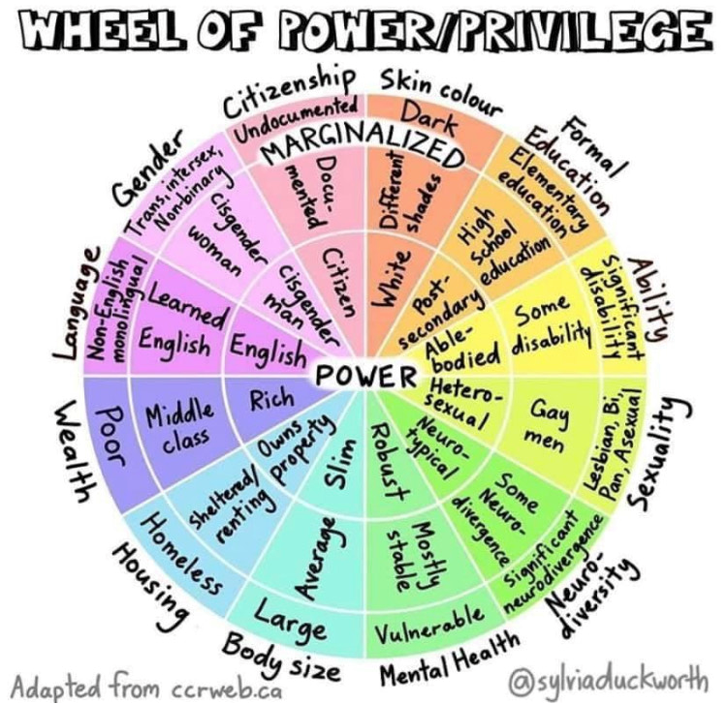
The wheel of power, privilege and marginalisation created by Sylvia Duckworth. The closer we are to the centre of the wheel, the less discrimination we are likely to face.

Bernardo is a Brazilian lawyer and a researcher from the Global South.
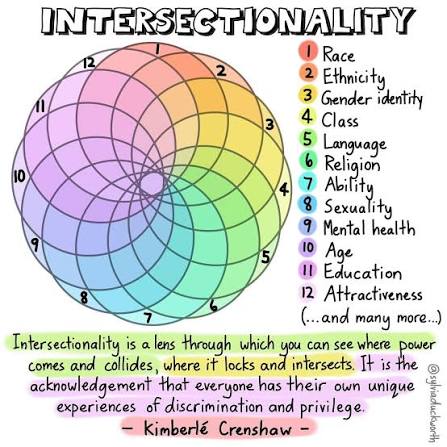
“Intersectionality is a concept associated with the American legal scholar Kimberlé Crenshaw,” says Bernardo. “It explains how identities and systems of power interact.”

The taxonomy also asks whether the discrimination is direct, cultural or structural, mirroring Johan Galtung’s theory of violence. “Galtung, a Norwegian sociologist, distinguished between three interconnected forms of violence: direct violence, structural violence and cultural violence,” says Bernardo. “The murder of George Floyd provides a powerful illustration of how these forms can interact.”
In the summer of 2020, George Floyd, a 46-year-old Black man, was murdered by a police officer in Minneapolis. “The physical force used against Floyd was an act of direct violence,” says Bernardo. “However, the event did not occur in a social vacuum.” Instead, it took place within a broader history of racial inequality in policing and the criminal justice system.
“Black communities in the US have faced disproportionate surveillance, arrest, imprisonment and police violence,” explains Bernardo. “These patterns are examples of structural violence because they are connected to the operation of institutions rather than an individual.”
Cultural violence embedded in American life made this direct and structural violence possible. “It can be seen in racist stereotypes that portray Black men as threatening or dangerous,” says Bernardo. “Such stereotypes can influence how police officers, members of the public and institutions interpret behaviour, and they may also be used to excuse excessive force or to treat violence against Black people as less serious.”
In many cases, these three forms of violence reinforce each other. Cultural stereotypes help legitimise unequal systems, and those structures place certain communities at greater risk of direct violence. “Galtung’s theory supports my taxonomy because discrimination has a similar structure,” says Bernardo. “Some discrimination is direct and visible, such as a person being refused a job because of their race. Other forms are embedded in institutions, such as recruitment systems that repeatedly exclude certain communities. And cultural attitudes may be used to explain or justify that exclusion.”
By drawing on Galtung’s theory, Bernardo’s taxonomy prompts judges to ask not only who acted and what happened, but also what structures made the harm more likely and what ideas made it appear acceptable. “A judge who decides not to recognise an intersectional or structural dimension of discrimination should at least explain why,” says Bernardo. “Ultimately, I want the taxonomy to make it harder for legally inconvenient parts of a person’s experience to disappear.”
 Bernardo de Mello
PhD candidate, Newcastle law School, Newcastle University
Field of research: Human rights law
Research project: Developing a new taxonomy of discrimination
About human rights law
“Human rights law deals with some of the most important questions a society can ask,” says Bernardo. “How should power be limited? What does every person need to live with dignity? How should societies respond when their laws or institutions exclude certain people?” To answer these questions, researchers and lawyers draw on information from a wide range of fields including philosophy, sociology, political theory, peace studies, history, feminist theory, critical race theory and decolonial thought.
“This is an exciting field because it connects abstract principles with people’s everyday lives,” says Bernardo. “A debate about equality may affect whether someone can attend school, form a family, access healthcare, participate in politics or remain safely in their home.” Progress is often slow, and research cannot transform society on its own, but advancing on a career in this field gives you the opportunity to play your part in the struggle for justice.
Looking to the future, human rights law research will have a major role to play in some of modern society’s most pressing issues. Artificial intelligence will raise questions about surveillance, privacy and algorithmic discrimination, climate change will create challenges involving displacement, access to food and water, and the rights of future generations, and researchers will continue to examine migration, war, authoritarianism, economic inequality, racism, gender-based violence, Indigenous rights and the criminalisation of LGBTQ+ people.
“Young researchers should not assume that every important question has already been answered,” says Bernardo. “Some of the most valuable work begins by noticing that the existing question has been framed incorrectly.”
Pathway from school to human rights law
Many subjects can help prepare you for work in human rights law. “Begin broadly,” says Bernardo. “Learn about history, politics and society as well as law.” Other subjects can also be useful such as philosophy, literature, geography, economics and languages.
“At university, studying law, politics, international relations, sociology, anthropology, philosophy, history, development studies or criminology can lead to human rights law,” says Bernardo. “Scientific and technical subjects are also increasingly relevant to human rights questions involving health, climate change and technology.”
Seek practical experience by joining debating clubs, taking part in a Model United Nations or volunteering with local charities, community organisations and legal clinics.
Explore careers in human rights law
Careers in this field include legal practice, academic research, teaching, diplomacy, journalism and humanitarian work. “Human rights knowledge is relevant in areas such as healthcare, technology, environmental protection, and equality and diversity,” says Bernardo. “A person does not need the job title ‘human rights lawyer’ to contribute to human rights.”
University human rights centres, the Oxford Human Rights Hub, legal blogs and recorded public lectures can introduce you to current debates.
“Start with local issues,” says Bernardo. “Human rights are present in schools, workplaces, neighbourhoods and local government. A small, responsible role in a community project can teach more than an impressive title with no meaningful work behind it.”
Meet Bernardo
As a teenager, I was always drawn to history, politics and questions about why societies develop in the way they do. I wanted to understand how past events continue to shape the present, especially in relation to inequality, power and the treatment of different groups. That interest led me to study history before I studied law, which taught me to look beyond individual events and think about the wider social, political and cultural forces behind them. It also showed me that many injustices do not appear suddenly; they are often connected to patterns that have developed over a long period of time.
My perspective as a Brazilian lawyer and a researcher from the Global South has shaped this project. Feminist, queer, decolonial and critical race scholarship taught me to question legal concepts presented as neutral or universal. These perspectives encourage us to ask whose experiences shaped a legal category, whose experiences are excluded and how the category might be improved.
The most rewarding part of my work is turning a highly theoretical argument into a practical tool. The taxonomy is not intended only to describe a problem. It is meant to help people reason about discrimination more carefully.
I am motivated by the fact that injustice can become invisible when the concepts used to describe it are inadequate. Courts may genuinely intend to protect human rights while still relying on categories that exclude important experiences. Improving those categories is therefore not a purely academic exercise. It affects whose suffering is recognised, whose evidence is believed and which changes an institution is required to make.
Curiosity is essential. Ask why a rule exists, who benefits from it and whose experience might be missing. Persistence is also important. Research involves rejected arguments, extensive revisions and periods when the solution is unclear. Progress often comes from returning to a problem several times rather than immediately finding the answer.
I also draw on empathy, independence and attention to language. A small difference in terminology can determine whether a person’s experience becomes legally visible. Feminist, queer and decolonial approaches have taught me to examine how knowledge is produced and whose perspectives are treated as authoritative.
Bernardo’s top tips
1. Practise explaining complicated ideas in ordinary language. Clear communication is one of the most valuable skills in human rights work.
2. Listen to affected communities. Human rights work should not be based on the assumption that researchers or lawyers always know what other people need.
3. Learn from criticism. Having an argument questioned is not the same as failing. It is part of making the argument stronger.
4. Rest is part of doing good research. Taking time away from a problem often makes it easier to see the solution when you return to it.
Do you have a question for Bernardo?
Write it in the comments box below and he will get back to you. (Remember, researchers are very busy people, so you may have to wait a few days.)
Learn about the systemic discrimination that Indigenous women and girls face:
0 Comments