
How can fiction increase students’ understanding of science?
“The division between literary studies and STEM is such that they may as well be two different star systems,” says Dr Rhona Trauvitch, a Teaching Professor of English at Florida International University in the US. Yet she believes that connections between these fields can hugely benefit all learners, which is why she is using analogies from fiction to help illustrate concepts in science.
What do the Muppets have to do with quantum physics? More than meets the eye, according to Dr Rhona Trauvitch, founding director of the Science & Fiction Lab at Florida International University (FIU). She is encouraging STEM educators to use analogies from fiction to explain concepts in science, and her favourite example is how the Muppets can be used to illuminate quantum superposition.
This counterintuitive physics phenomenon describes the condition of a quantum particle that is simultaneously in incompatible states. A rather perplexing concept for students to wrap their heads around! But the shape of this concept manifests in the Muppets, and Rhona believes students might have a much easier time conceptualising the phenomenon once they add the perspective of fiction into the mix.
We all know that the Muppets are fictional TV characters. Despite this, they also exist in the non-fictional real world – they are interviewed on talk shows, appear at award ceremonies, author magazine articles and host their own Instagram accounts. Which means that, analogous to quantum particles, the Muppets are in a superposition of states – in this case, simultaneously fictional and not fictional.
The importance of analogies
“According to Douglas Hofstadter and Emmanuel Sander, whenever we come across something new, we automatically compare it to something we already know that is similar in some way,” says Rhona. “In other words, we approach new ideas by making analogies.” This allows us to make sense of the new information by relating it to ideas we already understand. As such, analogies are a powerful pedagogical tool for explaining new concepts to students.
Using analogies from fiction to explain science
The challenge with finding science analogies is that certain science phenomena are so complex that we have nothing to compare them to. “By definition, a concept that is counterintuitive cannot be linked to anything we would recognise from our embodied experience of the world” [2], writes Rhona in her book, Fi-Sci: Avatars of Science in Fiction. She elaborates, “Objects in our everyday observed reality do not behave like quantum particles, so it is difficult to come up with something that is like superposition. Instead, we may need to consider objects that are not bound by reality and ideas that do not correspond to our embodied experiences.” Which is why Rhona turns to fiction.
We can find analogies for complex science phenomena in the realm of fiction because the very nature of fiction asks us to imagine the non-actual and even the impossible. “When we experience fiction – in a book, movie or video game – we shed the assumptions we make when encountering non-fiction narratives and accept the fantastical or counterintuitive ideas presented,” explains Rhona. “We add these accepted ideas to our mental repertoire of concepts, which now includes notions that may indeed be comparable to complex or counterintuitive science.”
How fi-sci differs from sci-fi
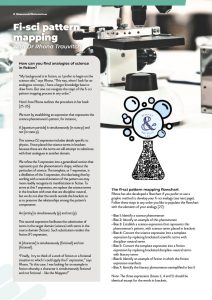
Rhona calls the process of identifying a phenomenon in fiction that is analogous to a phenomenon in science ‘fiction-to-science (fi-sci) pattern mapping’. A key aspect of fi-sci is that it does not depend on fiction that features science, such as science fiction (sci-fi). “Fi-sci describes a different relationship between fiction and science,” says Rhona. “Its analogies may be located in fiction that has no obvious connection to science.”
While sci-fi contains literal manifestations of science phenomena (e.g., a plot about time travel), fi-sci searches for figurative manifestations of the phenomena. The aim of fi-sci is not to find the science itself within the fiction, but to find “the pattern of the science phenomenon… mirrored in some aspect of the fictive discourse” [4], writes Rhona. “Manifestations can arise in a narrative’s structure or plot; in the reading or viewing experience; in the story’s setup; via literary devices” [33].
For example, the film Interstellar does not provide an analogy for wormholes and spacetime curvature – these are literally manifested in the plot. Instead, Rhona searches fiction for figurative manifestations – avatars of the science in the fiction. “Both a wormhole and the metalepsis [a jump across narrative levels] in Julio Cortázar’s story “Continuidad de los parques” [“Continuity of Parks”] connect two entities that effectively should not be able to meet,” she writes. “It is not that a character in “Continuidad de los parques” enters a wormhole; the story has nothing to do with literal spacetime curvature. Rather, a character therein experiences a process that is like what happens when spacetime curves: The character intersects with something (another character) that intuitively should be in a different reality – in other words, out of reach” [32-33].
The benefits of interdisciplinary learning
Rhona teaches a course called ‘Quantum Narratology and Other Curiosities: Intersections of Science and Storytelling’ to students at FIU, where she introduces the concept of fi-sci pattern mapping and tasks students with developing their own fi-sci analogies. “This is an elective course taken by students from various degree programmes, including STEM, humanities and social sciences, which means the already interdisciplinary course is given an extra boost by the perspectives of students with experience across different disciplines,” she explains.
Fi-sci does not only show STEM students a novel way to view and communicate the science they’re learning – the interdisciplinary thinking it promotes is equally important for everyone. “Whether studying humanities or STEM, students who map fi-sci analogies gain cross-disciplinary proficiency and the ability to convey complex processes to a non-specialist audience,” says Rhona. “Recognising the pattern of a science phenomenon in a field as far removed as literature encourages creativity, critical thinking and a more holistic understanding of both science and fiction.”
Further examples of fi-sci analogies
Another of Rhona’s favourite analogies was created by one of her students, a philosophy major, who noticed the similarities between dark matter and aspects of Jacob’s Room by Virginia Woolf. Readers never directly observe Jacob, they only know about him from descriptions given by other characters. Analogously, scientists have never directly observed dark matter, they only know about it from the way it impacts its surroundings.
80 Days is an interactive video game in which players choose their own route through the game, thereby impacting the story’s plot and narrative outcomes. This compares with the scientific process of genetic engineering, in which scientists reorganise genes to produce a different outcome in an organism. “Choose-your-own adventure stories and genetic engineering both involve the rearrangement of elemental units, highlighting the concept of permutative agency,” explains Rhona.
Reference
https://doi.org/10.33424/FUTURUM733


Finding such connections between science and fiction can, Rhona believes, help enhance the learning of students from all disciplines. “One measure of success after university is a graduate’s ability to translate knowledge and competencies gained in school to the world beyond academia,” she says. “Yet prevailing structures of higher education are not necessarily conducive to this. The fi-sci project aims to break down disciplinary silos and better equip students for the world beyond the campus, using the instrument of fictionality.”
 Dr Rhona Trauvitch
Science & Fiction Lab, Florida International University, USA
Fields of research: Narratology; interdisciplinary analogical reasoning; STEM education
Research project: Leveraging the rhetorical power of fiction to make STEM more accessible
Funders: This work is supported by the US National Science Foundation (NSF) under Award No. 2518840 and the National Endowment for the Humanities (NEH). Any opinions, findings, conclusions or recommendations expressed in this material are those of the author and do not necessarily reflect the views of the NSF or NEH.
Website: scienceandfiction.fiu.edu
Portions of this article quote or paraphrase Fi-Sci: Avatars of Science in Fiction by Rhona Trauvitch, published November 2026 by The Ohio State University Press © 2026 The Ohio State University
Testing the impact of fi-sci
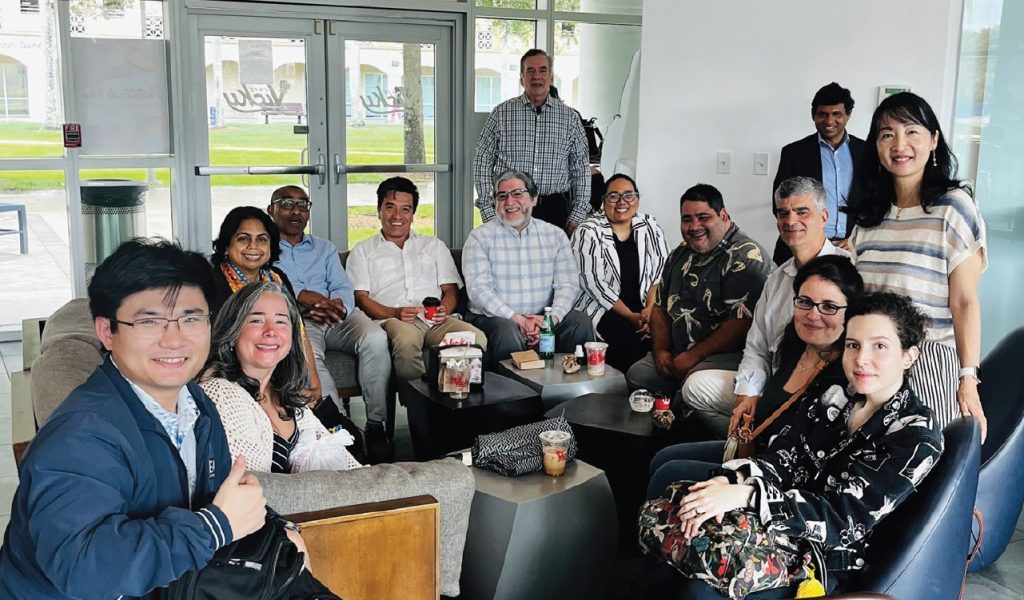
Having developed her fi-sci pattern mapping framework, Rhona is now leading a research project to explore the effectiveness of fi-sci as a teaching method, along with her colleagues Dr Tiberio Garza, Dr Bryan Dewsbury and Nicole Chlebek. FIU faculty participating in the project were paired across disciplines, each duo comprising one member who teaches fiction (including faculty in English, philosophy, history and law) and one who teaches STEM.
In each pair, the faculty shared the curricula of the courses they teach then looked for topics that are analogous across the disciplines. “The magic happened in these conversations,” enthuses Rhona. “As one person described a topic, the other thought about the topics they teach and considered whether they might have a similar form. These discussions always led to a moment when something clicked – the sign of an elegant interdisciplinary analogy.”
The pair then developed lesson plans for a ‘jigsaw module’ that linked their specialisations by way of fi-sci analogies. The first lesson introduces students to the analogy while the second shows them how it was generated through the fi-sci pattern mapping process.
Evaluating the effects of fi-sci on student learning
Rhona and her colleagues will now assess the impact of the fi-sci jigsaw modules by testing control and experimental groups of students before and after they take part in the fi-sci intervention. To do so, the participating faculty will begin by teaching a topic to all their students (without using fi-sci analogies). Students will then complete an assignment to introduce that topic to a friend who is not studying the course and to a fifth grader, and to make an analogy between any concept in STEM and any concept in fiction.
All students will then participate in a lesson giving an overview of analogies as thinking and learning tools. The experimental group of students will then participate in the two fi-sci pattern mapping lessons, learning the fi-sci analogy that links the topic they learnt in the initial lesson to a topic taught in their professor’s partner’s course, followed by learning how the analogy was generated. All students will then complete the same assignment again but in reverse order, making an analogy between any concept in STEM and any concept in fiction, then explaining the same topic to a friend who is not studying the course and to a fifth grader.
“We will evaluate whether learning about the power of analogies leads both groups to perform better in the second assignment and whether learning about fi-sci analogies and pattern mapping in particular increases the improvement of the experimental group,” explains Rhona. “We hypothesise that the experimental group’s improvement will surpass the control group’s improvement in terms of interdisciplinary perspective, critical thinking and subject matter communication.”
The jigsaw module library
The jigsaw modules developed during this project will be collated in a digital library for any FIU faculty to use and adapt for their own courses. “In the future, we plan to expand access to the library so the teaching materials are freely available to staff and students at any university,” says Rhona. “Any educator would be able to browse the digital catalogue to find a module built around an analogy that involves a topic they’re teaching, then they could use it in their own course, while adapting it to match their curriculum.”
Advice for educators
Common challenges for implementing fi-sci teaching
“The biggest hurdle I face when introducing the concept of fi-sci analogies is the confusion between the literal and the figurative,” says Rhona. “Initially, students come up with cases of fiction that feature science, such as genetic engineering or time dilation.” But these include the science itself, rather than narrative elements or manoeuvres that are analogous to the science concepts. The difference between literal and figurative manifestations of science within fiction is a key message to convey to your students.
One common challenge educators encounter when trying to incorporate fiction analogies in their STEM classes is simply a lack of time to fit fi-sci into an already-packed curriculum. “You might find it difficult to set aside time to show your students how a concept they have just covered is analogous to a concept in a different field,” says Rhona, who has three suggestions for how to overcome this. “If possible, you could shorten other lessons to create room for a fi-sci intervention. You could adopt a more condensed version of the fi-sci jigsaw model. Or you could move some of the instructional material online so it takes up less class time.”
While many students enjoy learning about how the subject they are studying manifests in a completely different discipline, another challenge you might face is students who do not see the value in making interdisciplinary connections. “Some STEM students may not recognise the relevance of fiction and will make comments like ‘I didn’t take a science course to read and discuss literature’,” says Rhona. If you encounter this, Rhona recommends emphasising the benefits of interdisciplinary fluency and demonstrating how a fi-sci approach can help students communicate their expertise to a non-specialist audience.
The benefits of fi-sci teaching and learning
“Through fi-sci pattern mapping, students gain exposure to concepts and methods they would have otherwise not encountered in the typical compartmentalised university structure,” says Rhona. “In doing so, they see their own subject in a new light, observe how it intersects with other fields and use it to increase their understanding of other subjects. This enables them to discover novel applications for their skills, which can translate into innovative job opportunities.”
And it is not only students who benefit from fi-sci teaching. “The process of developing fi-sci analogies has been greatly beneficial to the participating faculty,” says Rhona. “Several have told us how much they’ve enjoyed working with colleagues in other disciplines who they may never have met were it not for the fi-sci initiative.” Several faculty have also commented on the excitement of including such a creative approach in their classes.
Do you have a question for Rhona?
Write it in the comments box below and she will get back to you. (Remember, researchers are very busy people, so you may have to wait a few days.)

Discover how art can also help scientists:
0 Comments