
Building better AI: how are computer scientists improving AI systems?
As artificial intelligence (AI) plays an ever-greater role in our lives, computer scientists are constantly improving AI systems. At the University of Molise in Italy, Professor Remo Pareschi has developed a more effective AI framework that allows humans and AI agents to work together to solve complex problems.
Talk like a computer scientist
AI agent – a software system that can perform a task on its own, such as analysing data or making decisions
AI framework – the underlying structure that determines how AI agents are organised and work together
Artificial intelligence (AI) – a computer system that mimics human intelligence in its ability to understand information and make reasoned decisions
Large language model (LLM) – a type of AI trained on large amounts of text that can understand and generate human language
Semantic processing – understanding the meaning of information
Topic space – a structured channel through which AI agents communicate about a particular topic, separated from other topics
Today, we rely on artificial intelligence (AI) to perform a huge range of tasks. With its ability to analyse data and make decisions, AI can do everything from acting as a virtual personal assistant to helping doctors diagnose diseases. However, traditional AI frameworks face several challenges that limit their ability to complete tasks effectively. So Professor Remo Pareschi, a computer scientist at the University of Molise, has developed a new AI framework that is more organised and effective.
What are the problems with traditional AI frameworks?
In traditional AI frameworks, AI agents communicate through a large language model (LLM) that sits at the centre of the system. The LLM acts as the controller, interpreting messages from each agent (known as semantic processing) and coordinating how agents interact. “This approach works well for many tasks, especially those involving language,” says Remo. “However, the reliance on LLMs as the central model can slow things down and it can become difficult to manage as the number of agents and interactions grows.”
Imagine asking a classmate to pass a note to your friend. This method of communication works well when two of you are passing notes back and forth through your classmate. But imagine if the rest of the class joins in the written conversation. There are now 30 people trying to communicate with each other, and every message must be passed on by that one original classmate. This will cause a bottleneck in communication because the classmate at the centre of the system will not be able to process and respond to all the information fast enough. Additionally, as the classmate at the centre is doing two completely different jobs at once (understanding what each note says and deciding who should get it next), neither job gets done as well as it could.
What is Remo’s new framework?
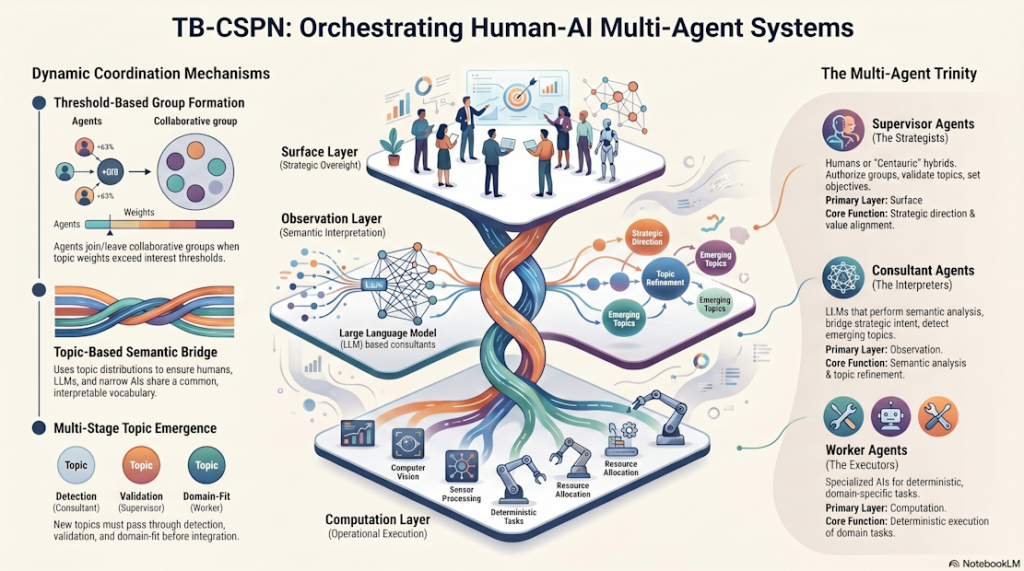
To address these challenges, Remo and his colleagues, Professor Paolo Bottoni and Professor Uwe Borghoff, developed a Topic-Based Communication Space Petri Net (TB-CSPN) AI framework. “The TB-CSPN framework organises AI agents differently,” Remo explains. “Instead of sending messages directly to each other through the LLM, agents communicate through shared topic spaces.” Agents interact with each other within structured spaces, where information is grouped by topic. LLMs are still used to understand and generate meaning, but other AI components control and coordinate the system.
The key innovation in the team’s TB-CSPN framework is that roles are separated, rather than all being performed by a central LLM. “In TB-CSPN, some components focus on semantic processing while others focus on coordination (organising who does what and when),” Remo explains. “Because these roles are separated, each part of the system can work more effectively. In simple terms, it turns a chaotic conversation into a well-organised collaboration.”
Reference
https://doi.org/10.33424/FUTURUM699


As AI increasingly takes on the routine task of writing code, computer scientists will need a broader intellectual foundation. © Gorodenkoff/Shutterstock.com

To overcome the limitations of traditional AI frameworks, Remo and his colleagues had to ensure that their new TB-CSPN framework was effective, transparent and scalable. “One of the main challenges was designing a system where multiple agents can cooperate effectively without becoming too complex,” he says. “Another challenge was ensuring that the system remained clear and interpretable, so that humans can understand how decisions are made.” The structure Remo’s team has developed – where agent communication occurs through topic spaces and semantic processing is separated from coordination – allows the TB-CSPN framework to achieve this. Without the LLM bottleneck at the centre of the AI system, TB-CSPN speeds up decision-making and enables easier tracking of how decisions have been made. In addition, new agents can be added without disrupting the system.
How could TB-CSPN help solve real-world problems?
“TB-CSPN can be used in many real-world situations where multiple types of information must be combined,” says Remo. “Examples include managing emergency responses (e.g., floods or wildfires) and supporting sustainable agriculture. In each case, different AI agents in the system analyse distinct aspects of the problem and collaborate to support human decision-making.”
In an AI system designed to help with emergency management, separate AI agents would specialise in weather, transport and safety, each communicating through dedicated topic spaces. Humans would hold authority over the structure of the system itself, such as what each agent is permitted to do and under what conditions actions can be taken. This means humans do not have to monitor every step, but they remain in control of the overall process. Information produced by the AI system would then be shared with humans, who would use it to make decisions about the appropriate emergency response.
“In this vision, AI is not meant to replace humans, but to work alongside them as part of a coordinated system,” explains Remo. “Human experts remain involved in key decisions, especially in complex or sensitive situations such as emergency management or environmental planning.” TB-CSPN is a practical way to implement this vision as it provides a structure in which both AI agents and humans can contribute to shared information spaces, with each bringing their own strengths to the process: “AI systems can analyse large amounts of data quickly, while humans can provide judgment, experience and ethical reasoning.”
“More broadly, this research explores how to design AI systems that behave less like isolated tools and more like organised communities, where humans and AI agents cooperate to solve complex problems together,” continues Remo. “Understanding how to build these collaborative systems may be one of the most important challenges for the future of artificial intelligence.”
 Professor Remo Pareschi
Stake Lab, University of Molise, Italy
Fields of research: Artificial intelligence (AI); computer science
Research project: Developing a new and more effective AI framework
Funders: This research was developed within the broader context of the METROFOOD-IT project and the Vitality project, both funded through the Italian National Recovery and Resilience Plan (PNRR).
About computer science
Our increasing reliance on computer systems in everyday life provides a wealth of opportunities and challenges for computer scientists. “I look at computing not just as a matter of writing code efficiently, but as a way of shaping how different kinds of agents – people, software, robots, sensor networks, AI models – interact with each other and the infrastructures they inhabit,” says Remo. “The challenge for the next generation of computer scientists will be to figure out how to make these hybrid systems work well together safely and intelligibly.”
Yet it is precisely these challenges that make the work so rewarding. “There is something deeply satisfying about starting from a formal idea and then watching it come to life as part of a working system that real people rely on,” says Remo. “Computer science’s most valuable contributions to society are going to come from designing systems that balance the theoretical side with human context.”
What skills do computer scientists need?
“A computer scientist who has technical depth, conceptual breadth and the ability to connect with people and organisations will be extraordinarily well-equipped for the decades ahead,” says Remo. He divides the skills required by computer scientists into three categories: technical fluency, foundational reasoning and soft skills. “Technical fluency means having solid programming skills, a good grasp of data structures and algorithms, and familiarity with platforms such as the cloud and AI frameworks,” he explains. “Foundational reasoning means being able to logically and analytically design systems and evaluate what AI is producing. Finally, it is important to be able to work well in a team, communicate clearly and understand the human context in which your computer systems will operate.”
Pathway from school to computer science
Develop your coding skills by learning a computer language such as Python or R and exploring software repositories such as GitHub. “There is no better way to understand how real systems work than to explore them,” advises Remo.
While coding is an essential skill for computer scientists, Remo highlights that, as AI increasingly takes on the routine task of writing code, computer scientists will need a broader intellectual foundation. “Study mathematics and philosophy, which will teach you to reason about abstract structures and spot hidden assumptions,” he says. “Logic is where mathematics and philosophy meet, and it underlies how computers reason. Study cognitive science because understanding how people think is crucial for designing systems that work with people. And don’t underestimate the value of being able to communicate clearly.”
At university, study a degree in computer science, information technology or computer engineering.
Explore careers in computer science
In today’s digital world, career opportunities for computer scientists are endless.
“To be a computer scientist today is to have the opportunity to be at the centre of things as they are now and as they are still to come,” enthuses Remo. “We are moving into a world where the digital, physical and social increasingly overlap. And through artificial intelligence, we are watching something genuinely unprecedented take shape.”
Prospects provides information about what you can do with a degree in computer science: prospects.ac.uk/careers-advice/what-can-i-do-with-my-degree/computer-science/
Meet Remo
When I was young, I was curious about everything. I had a set of encyclopaedias – a row of heavy volumes on a shelf – that I would pull down, flip open and lose myself in for an hour. I read them constantly, wandering from one topic to the next. It was nothing like what is available today, with Wikipedia and AI assistants to answer almost any question you can think of.
I attended a ‘classical’ Italian high school where I spent years studying Latin, Ancient Greek, literature and philosophy, before going to university to study computer science at a time when the digital world was beginning to take shape. My background in classical studies shows there is no incompatibility between the humanities and sciences – the two worlds speak to each other far more than people tend to assume.
I spent several years leading research and innovation teams at the European Computer-Industry Research Centre and Xerox, where I guided technology projects from early-stage ideas through to real products and services. My industry experience was a real asset when I became an academic computer scientist – understanding how a business works and how technology is brought to market gives me a different perspective from my colleagues. And this perspective has allowed me to create spin-off companies from the results of my research.
I enjoy reading in my free time, from Wikipedia articles about the evolution of life to science fiction to classic British humour. Reading widely across genres teaches you to move between different registers of thought, which is extremely useful when you work, as I do, at the intersection of formal ideas and real-world systems. I also think that anyone thinking about artificial intelligence should spend time wondering how the natural kind ever came about in the first place.
Remo’s top tip
Don’t hesitate to take side paths. I’ve done it many times – from classical studies to computer science, from academia to industry and back again, and from research into spin-off companies. Side paths are where original ideas, unexpected connections and the most interesting work tend to appear. A perfectly straight career is rarely the most creative one.
Do you have a question for Remo?
Write it in the comments box below and he will get back to you. (Remember, researchers are very busy people, so you may have to wait a few days.)
Discover how infrastructure systems engineers are also developing AI for disaster responses:
futurumcareers.com/building-community-resilience-for-disaster-response
0 Comments