
Forecasting frost to protect cranberry crops
Cranberries contribute a huge amount of money to North American economies, yet a single frosty night can destroy an entire crop in a matter of hours. Taking vital measures to protect cranberries from frost relies on being able to predict their stages of development and understanding when they are most vulnerable. At the University of Massachusetts Amherst in the US, Dr Peter Jeranyama is studying three predictive models to understand which is the most useful for helping growers protect their crops and continue providing the world with this superfood.
Talk like a plant physiologist
Dormancy — a period when an organism stops growth and development to withstand harsh environmental conditions
Exothermic — a process or reaction that releases heat
Growing degree days — a measure of accumulated heat used to predict plant development over time
Phenology — the study of cyclic and seasonal patterns in nature
Physiology — the branch of biology that studies how organisms function, including their organs, cells and molecules
Phytochemical — naturally occurring chemicals found in plants
Tannin — a biomolecule found in plants
Thermal — related to heat
Yield — the amount of crops produced
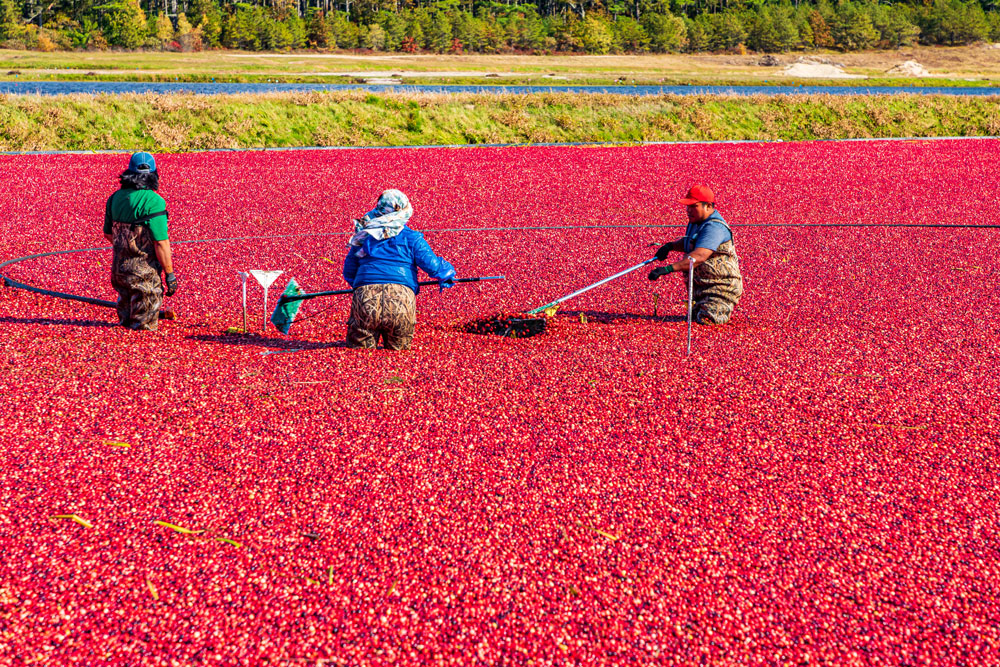
Cranberries are small, red berries, native to North America, that have a well-earnt reputation as a superfood. “They are rich in antioxidants, phytochemicals and tannins, which promote gastrointestinal health and stave off diseases such as cancer,” says Dr Peter Jeranyama from the University of Massachusetts Amherst. “The US and Canada produce the majority of the world’s commercial cranberries, creating an industry worth over $1 billion to North America.”
However, ensuring a strong cranberry harvest is not always easy. Cranberries are susceptible to adverse weather conditions, in particular drought and frost. “The spring months can bring with them severe frost events, which can greatly impact the quantity and quality of yield,” explains Peter. “Frost can destroy an entire season’s harvest in a matter of a few hours.” To address this, Peter is helping growers to track their crops’ development and understand, in advance, when they need protection from frost.
Physiology and phenology
Reference
https://doi.org/10.33424/FUTURUM672
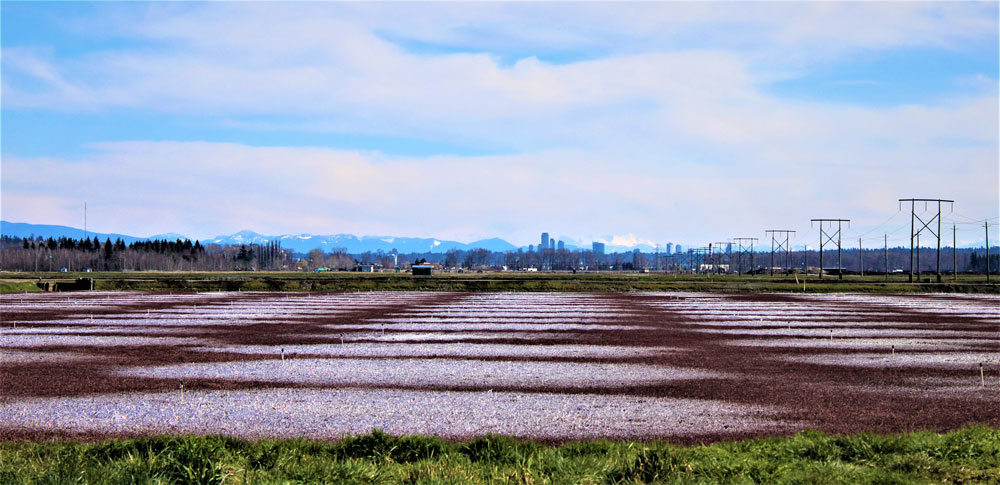

To protect their crops from spring frosts, growers rely on a number of methods. “Approaches include wind turbines or blowers,” says Peter. “The main approach, however, uses sprinkler irrigation.” On frosty nights, water is applied to cranberry crops, where it freezes. Counterintuitively, the freezing of water is exothermic – it releases energy, in the form of heat – which warms the adjacent cranberries enough to prevent frost damage. “This is because the change of water from a liquid to a solid involves the breaking of hydrogen bonds,” says Peter. “The breaking of these bonds, which give ice its structure, releases energy.”
Interestingly, growers only need to provide frost protection once the weather begins to get warmer. Cranberry plants endure freezing winters without coming to harm, so why do they suddenly become vulnerable in the spring? “Warming temperatures in the spring stimulate cranberry buds to break dormancy and begin developing,” explains Peter. “At the same time, they lose their ability to withstand cold temperatures.” These effects are explored by phenologists who study how the changing seasons and other cycles stimulate changes in plants and animals’ physiologies.
Growing degree days
So, growers have measures to protect against frost, but using these measures effectively relies upon being able to predict when cranberry buds have developed enough to need this protection. Doing this involves accurately tracking their crops’ phenology using mathematical models. “For the Massachusetts cranberry industry, most growers use the Franklin model, a frost forecasting model first developed in the 1940s,” says Peter. “However, many growers have questioned the usefulness of this model and are eager for a more robust and accurate approach.”
To help meet this need, Peter turned to thermal models – models that use temperature data to predict a crop’s growth, development and stress over time. “The main output of these models is the calculation of growing degree days (GDD),” says Peter. “GDD measures how many days throughout the year have been sufficiently warm enough for growth, which relates to development and vulnerability to frost.”
This is a way of quantifying phenology: when a cranberry plant has surpassed a certain GDD value, it is likely that its buds have broken dormancy and become vulnerable to frost. “For example, using one thermal model called the Dee model, we start monitoring for potential frost damage once 100 GDD has been reached,” says Peter. “We call this the critical GDD.” But for models to be useful, they need to closely mirror reality, and this was the focus of Peter’s investigations.
The results are in
Peter compared the Dee model with two other models, which have different temperature thresholds for defining whether a day is a GDD or not, among other differences. “We verified these models with actual bud samples that we examined under the microscope to determine their phenology,” explains Peter. “We found that for most years, all three models have a margin of error of one to three days around when the critical GDD has been achieved.” However, when it came to abnormal years with less predictable spring temperatures, one model – known as the Wisconsin complex model – was more accurate than the others.
Peter’s project also revealed a troubling finding: across 65 years of data, the critical GDD has been surpassed earlier and earlier in recent years. “This means that cranberry buds are developing earlier, which increases the risk of frost damage,” says Peter. “This is related to rising average air temperatures.” This is almost certainly an impact of climate change, which is disrupting the phenologies of countless species, both wild species and commercial crops that are important for human health.
Peter hopes that his research can help growers meet the challenges of a changing world. “Now, I’m working on improving spring frost forecasting in cranberries by combining field observations with machine learning techniques,” he says. “Our ability to develop good models depends on accurate data collection and curation, and analytical strength.”
What would you investigate as a plant physiologist?
 Dr Peter Jeranyama
Cranberry Station, Center for Agriculture, Food, and the Environment, University of Massachusetts Amherst, USA
Field of research: Plant physiology
Research project: Advancements in spring frost protection to sustain cranberry production in Massachusetts. Jeranyama P., Kennedy C. (2021) doi: 10.1002/agj2.20928
Funders: US Department of Agriculture’s Agricultural Research Service (USDA ARS); Cape Cod Cranberry Growers Association (CCCGA)
Do you have a question for Peter?
Write it in the comments box below and he will get back to you. (Remember, researchers are very busy people, so you may have to wait a few days.)
0 Comments