
How can studying microplastics and micropollutants protect human health?
Microplastics have the rather unhelpful habit of attracting and transporting other micropollutants such as pesticides, dyes and pharmaceuticals, often causing them to accumulate in levels harmful to humans, animals and the environment. At Kansas State University in the US, Professor Daniel Higgins is using advanced microscopy techniques to investigate how micropollutants are attached to, transported by and released from microplastics, increasing our understanding of the risks they pose.
Talk like a chemist
Confocal fluorescence correlation spectroscopy (FCS) – a technique that measures how many fluorescent molecules are present and how quickly they move by analysing changes in the light they emit
Hydrophilic – water-seeking
Hydrophobic – water-avoidant
Lipophilic – fat-seeking
Microplastic – tiny plastic pieces (less than 5 mm) often from broken down plastic litter, fabrics or small beads in toiletries
Micropollutant – any harmful chemical or substance present in the environment at extremely low concentrations (typically micrograms or nanograms per litre)
Organic micropollutant – carbon-based micropollutants, often synthetically created by humans such as pharmaceuticals, pesticides or toiletries
Super-resolved single-molecule tracking (SMT) – a technique that tracks the movements and interactions of individual fluorescent molecules at extremely small scales
Micropollutants are everywhere – in the oceans, soil, air and even our drinking water and our bodies. They are normally found at extremely low concentrations, but can accumulate and harm humans and animals, causing cancer and other diseases.
“Organic micropollutants are commonly synthetic, carbon-based molecules created by humans, including pharmaceuticals, pesticides, dyes, adhesives and other chemicals that have been released into the environment,” says Professor Daniel Higgins, a chemist at Kansas State University. “They are found at very low concentrations, often around a nanogram per litre of water.” This is roughly equivalent to one drop of water in twenty large swimming pools. However, they can still be dangerous as many such molecules are lipophilic (fat-seeking) and so accumulate and concentrate in the fatty tissues of humans and animals.
Microplastics and micropollutants
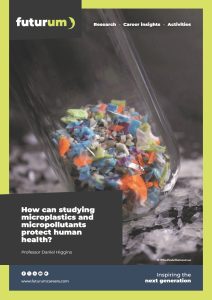
Microplastics are tiny plastic pieces, from one micrometre to five millimetres in size. Primary microplastics are created that size, such as craft glitters, industrial powders and the beads found in body scrubs, while secondary microplastics are shed from larger plastic items, such as food and drink containers, as they break apart in the environment.
“When microplastics are exposed to sunlight, heat and Earth’s oxidising atmosphere, along with the mechanical forces imparted by wind and waves, the particles become weathered, change size and shape, and transition from being hydrophobic to hydrophilic,” says Dan. “This dramatically changes how they interact with other molecules like organic micropollutants.”
Microplastics are micropollutants themselves, but the way they interact with other micropollutants makes them even more problematic. Firstly, many microplastics come from coloured textiles or packaging where dyes have been combined with the plastic. “As these plastics weather to become microplastics, the dyes incorporated in them may be released into the environment as new surfaces are formed on the plastic particles,” says Dan.
Secondly, microplastics can transport other micropollutants. “Hydrophobic micropollutants readily accumulate on the hydrophobic surfaces of relatively fresh microplastics that have not yet undergone substantial oxidation, while hydrophilic micropollutants accumulate on heavily-oxidised hydrophilic surfaces of weathered microplastics,” says Dan. “In both cases, the micropollutants can become concentrated to levels well above those found in the environment, leading to possible toxic responses if they are ingested and the pollutants are released.”
Modelling microplastics and micropollutants
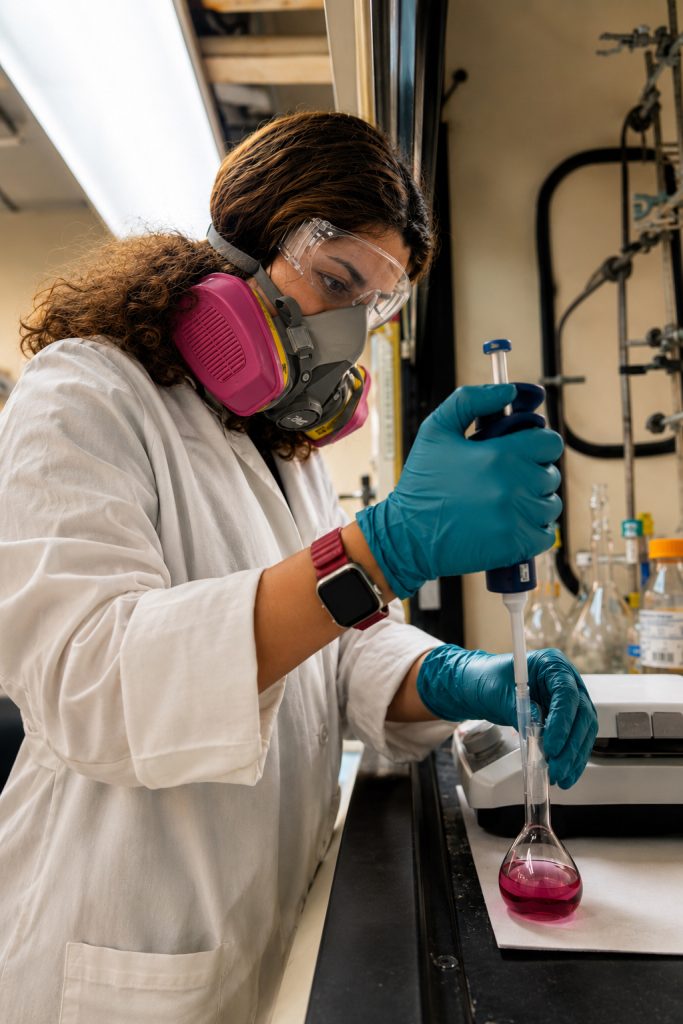
To study these processes, Dan and his students chose representative organic micropollutants and secondary microplastics that would be easy to study. “For a model micropollutant, we needed fluorescent molecules to detect and track at the single-molecule level,” explains Dan. The team chose rhodamine B, a common dye often found in the environment. For the model microplastic, they chose polyethylene terephthalate (PET). “PET is commonly used in disposable food and drink packaging, which may be carelessly discarded or escape during transport to waste management facilities,” says Dan. “PET is also widely used in textiles, like polyester clothing. As clothing becomes aged and worn, PET fibres are released directly into the environment.” Dan’s students used ultraviolet (UV) light to artificially age samples of PET microplastics. “Using UV light allows us to quickly produce changes similar to those caused by long-term exposure to sunlight and air under normal environmental conditions,” he explains.
Microscopic molecule movements
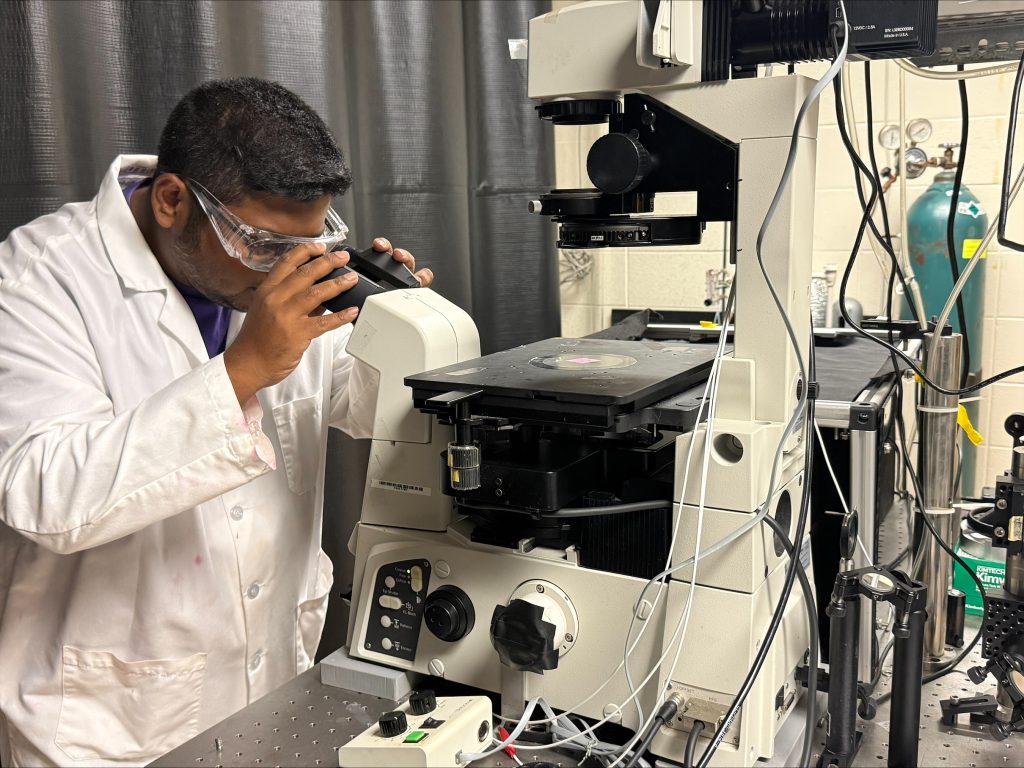
Optical microscopes allow scientists to view tiny objects, such as individual molecules, using light. Typical optical microscopy, which uses visible light, needs objects to be spaced out by roughly 300 nanometres to tell them apart. However, super-resolved single-molecule tracking (SMT) uses fluorescent dye molecules such as rhodamine B which, when illuminated with a laser, emit bright yellow light, allowing the location of individual molecules to be determined to within as little as 20 nanometres.
Using this technique, Dan’s students record videos of the molecules’ movements. “These videos show tiny bright spots of light against a dark background, much like stars in the night sky, but they are moving,” says Dan. “By recording these spots of light, we are ‘tracking’ the single molecules which tells us if the molecules are moving or where, when and how strongly they stick to the plastic surface.”
Reference
https://doi.org/10.33424/FUTURUM732
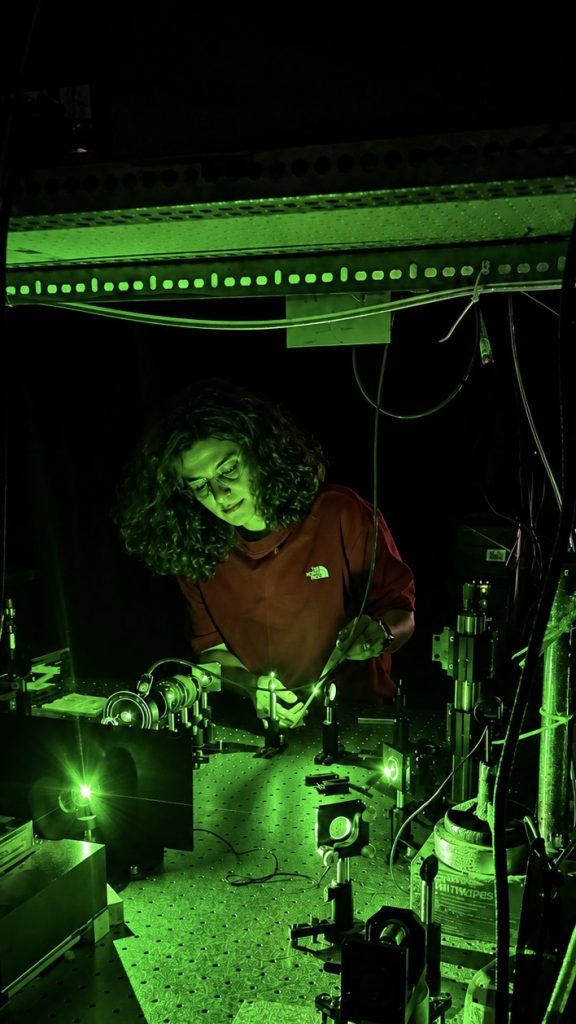

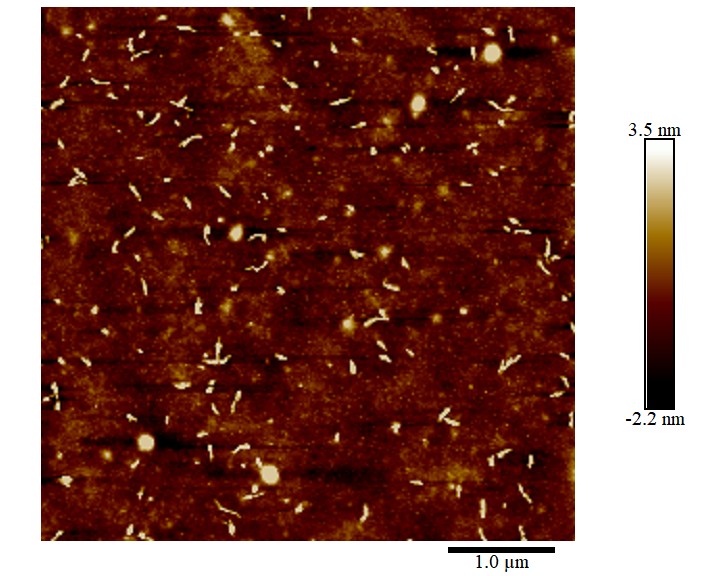

Whereas SMT shows how individual molecules behave, confocal fluorescence correlation spectroscopy (FCS) observes many molecules simultaneously, better revealing how fast they move and how many are present. When fluorescent dye molecules move through a microscope’s detection area, they produce brief bursts of light. A mathematical process called autocorrelation is used to analyse these bursts to learn about the molecules’ movements. “FCS allows us to precisely determine how fast the molecules are moving, even if they are moving very rapidly, or if they interact with the plastic surface for only very brief periods of time,” says Dan.
Findings and future steps
Dan and his students have discovered that the properties of microplastics vary across their surfaces, and at least two mechanisms cause interactions with micropollutants. “Unweathered (hydrophobic) plastic regions readily accumulate lipophilic molecules that are easily released when the plastic migrates into a different environment, such as when it is ingested by living creatures,” says Dan. “Weathered (hydrophilic) regions allow the microplastics to be more readily dispersed in water, and provide sites for certain organic micropollutants to become strongly attached to the microplastics.”
While there is still much research to be done, the team’s results are highly valuable. “Our results provide new clues as to how micropollutants behave when they interact with microplastics,” says Dan. “This helps us understand the true level of hazard posed by micropollutant-laden microplastics, while also providing ideas for how plastics may be altered to eliminate microplastics or better control their abilities to transport other hazardous chemicals.”
 Professor Daniel Higgins
Department of Chemistry, Kansas State University, USA
Field of research: Chemistry
Research project: Studying how micropollutant molecules accumulate on microplastic surfaces
Funder: The US National Science Foundation (NSF) supported this work through grant CHE-2502696. Any opinions, findings, and conclusions or recommendations expressed in this material are those of the authors and do not necessarily reflect the views of the NSF.
About chemistry
Being a chemist means learning about and working with the building blocks of matter. Chemists explore the properties of matter, how different substances interact and what happens when changes take place. “The best part of being a chemist, or a scientist in general, is the thrill of discovering new knowledge,” says Dan. “Whenever we perform experiments in the laboratory, we observe chemical phenomena that have either never been seen before, are not well understood or have not previously been explored by our methods.”
Chemists may be involved in many different activities. “Most professional chemists work in industry and may spend much of every day in a laboratory or factory running chemical syntheses, monitoring chemical processes, making chemical measurements or creating computer models of chemicals, their reactions and their properties,” says Dan. “Those working in national laboratories around the world do experiments, read scientific articles in their area of speciality and brainstorm creative ideas for new experiments, theories, synthetic chemicals and chemical materials.” University-based chemists are often also involved in teaching and mentoring students.
Future chemists will address the challenge of making new plastic food and drink packaging that is safer for humans and can be more easily recycled or degrades more effectively if released into the environment. “Micropollutants of great concern these days are poly- and perfluoroalkyl substances (PFAS), also known as ‘forever chemicals’,” says Dan. PFAS are very useful chemicals, found in non-stick coatings, lubricants and fire extinguishers, but they are also lipophilic and hazardous to humans and animals. “Chemists in the future will be working to make new materials that have similar useful properties but are far less persistent in the environment and far less hazardous.”
Pathway from school to chemistry
At school, focus on chemistry, mathematics and physics to build a strong base. “At university, students should take more in-depth courses in chemistry, biochemistry, math and physics,” says Dan. “Strong backgrounds in computer programming, modelling and data science are also becoming increasingly important.”
“Chemists need to be curious,” says Dan. “They need to be able to think creatively and come up with new ideas that will help solve or better understand the world’s existing and emerging problems. As modern chemistry is very much a collaborative science, they also need to be able to work closely with collaborators from chemistry and other sciences, and those from entirely different fields like business. Chemists must also be strong communicators who are able to explain complex chemical phenomena to other scientists, policy makers and the public.”
Explore careers in chemistry
Chemists can work in medicine, academia, national laboratories, or the chemical, pharmaceutical or consumer products industries. Chemists solve problems, create new products, get involved in policymaking and standards-setting, or teach and train the next generation of scientists.
“The American Chemical Society (acs.org) and the Royal Society of Chemistry (rsc.org) are the most well-known professional chemistry societies and encourage student membership,” says Dan. “They provide many helpful resources to chemists as they develop in their careers and many opportunities for networking.”
“There are many student-centred organisations, such as Alpha Chi Sigma and Phi Lambda Upsilon in the US for students in college or graduate school,” continues Dan. “These provide many opportunities and are excellent venues for meeting others and networking. For example, the Kansas State University local chapter of Alpha Chi Sigma provides extensive opportunities for students to become involved in outreach activities.”
Meet the team
 Mohammad Motiur Rahman
My high school science teacher inspired me to study chemistry. His ability to observe and explain daily phenomena was fascinating.
Every day in the lab is a dynamic, hands-on adventure! My role is an exciting mix of two worlds: as a teaching assistant, I get to help undergrads discover their own spark for chemistry, and as a research assistant, I dive deep into my own research. It’s collaborative, fast-paced and never boring!
Every experiment I run and every challenge I solve brings me closer to my ultimate dream: becoming an independent researcher who can bring positive changes in society to make our future lives more liveable.
Mohammad’s top tips
1. Look for the daily magic, not just formulas. Chemistry isn’t just equations on paper; it’s the secret code behind everything happening around us every second.
2. Treat lab setbacks like a puzzle. Real scientists don’t get things right on the first try! Learning through trial and error is half the fun, and solving a tricky problem feels amazing.
3. Dream big about impact. Chemistry gives you the power to tackle huge real-world challenges.
 Olawale Aina
I grew up in Lagos, Nigeria, and my grandfather, a retired geochemistry professor, used to take me on walks along the Lagos Lagoon. He’d explain how years of industrial pollution had changed the oily sheen on the water. Those walks planted a question in my head: What is actually happening to our water, at the smallest possible level?
I previously studied environmental management and toxicology, which shapes how I approach my chemistry research: always connecting the small details back to the bigger environmental picture.
I study how organic micropollutants stick to the surface of microplastics. Using SMT, I can watch individual molecules, and that level of detail helps explain why microplastics act like tiny sponges and delivery trucks for pollution in rivers, lakes and oceans.
I want to keep working at the intersection of chemistry and environmental protection, using science to answer real-world pollution questions to help communities like the one I grew up in.
Olawale’s top tips
1. Stay curious about the ‘why’ behind things you notice in the world around you.
2. Don’t be afraid to change direction once you find the question that really grabs you.
 Sorour Salehi
I did not grow up knowing I wanted to be a chemist. Over time, I became fascinated by the idea that things we cannot see can explain so much of what happens around us. Now, I get to connect that curiosity with an environmental problem that affects all of us: plastic pollution.
I enjoy the independence I have as a researcher. I have space to think, try new ideas, make mistakes, troubleshoot problems and slowly find my own way of doing research.
Research can be frustrating, but it teaches you patience and how to keep going when the answer is not clear. For me, turning small observations into new understanding is one of the most rewarding parts of being a scientist.
Sorour’s top tips
1. As a high school student, you do not need to know what you want to do – I’m still figuring out what I want my long-term career to look like!
2. Do not judge yourself by whether every class or experiment feels easy. Being a good scientist means being curious enough to keep asking questions when you do not know the answer.
Do you have a question for the team?
Write it in the comments box below and they will get back to you. (Remember, researchers are very busy people, so you may have to wait a few days.)

Learn what happens to plastics as they break down into microplastics:
futurumcareers.com/what-happens-when-plastics-break-down-into-microplastics-and-nanoplastics
0 Comments