
Making nuclear-powered space travel a reality
Nuclear reactions are capable of producing huge amounts of energy, which can be harnessed in nuclear power stations. However, current systems are limited by their size and durability. Dr Austin Lo, Chief Research Officer at GenAlpha Nuclear Technologies in the US, is developing a groundbreaking new technology to overcome these limitations. His innovation is paving the way for compact and long-lasting nuclear energy systems, which could open new frontiers for many industries, including space exploration.
Talk like a nuclear engineer
Clean energy transition — the global shift away from fossil fuels to clean energy sources
Low-temperature plasma — ionised gas in which the smaller, negatively-charged electrons have higher energy than the larger, positively-charged ions, allowing reactions to occur at lower temperatures
Metal foam — a solid metal with many gas-filled pores, like a sponge made of metal
Nuclear radiation — the energy released by the nuclei of unstable atoms in the form of particles or electromagnetic waves
Nuclear reactor — a device used to initiate and control a self-sustaining nuclear reaction
Photon — a particle representing the smallest possible unit of light
Thermionic energy conversion (TEC) — a method of directly converting heat into electrical energy without intermediate conversions, such as movement
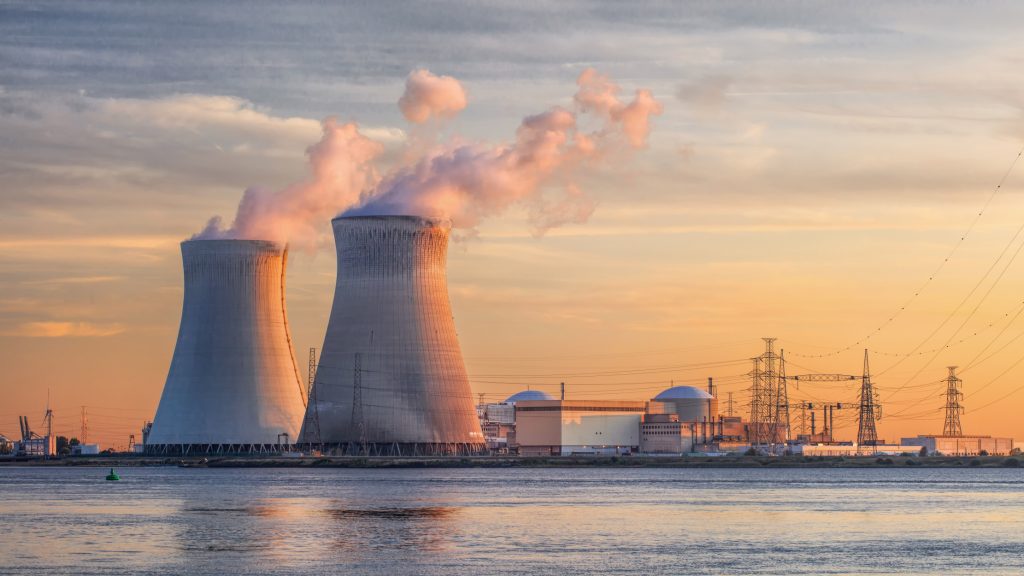
In most of our energy generation systems, heat is created and converted into electricity. For example, burning fossil fuels, such as coal and natural gas, generates heat, as do the nuclear reactions that take place in nuclear power plants. After this heat is created, both systems work on the same principles: the heat causes water to evaporate, creating high-pressure steam which spins turbines, creating mechanical energy that is converted to electrical energy by generators. But these intermediate steps – evaporating water and spinning turbines – require a lot of parts, space and ongoing maintenance.
While the fossil fuel industry is expected to wind down over the coming decades – because of its negative impacts on the climate – the nuclear industry could become a major source of clean energy in the future. Current nuclear power plants are massive and take a long time to plan and build, but Dr Austin Lo, Chief Research Officer at GenAlpha Nuclear Technologies, believes it is possible to harness a different, much more compact system to convert nuclear heat into electricity. Such a system would open up a huge range of new applications for nuclear energy – not least as a power source for the spacecraft of the future.
Thermionic energy conversion: cutting out the middleman
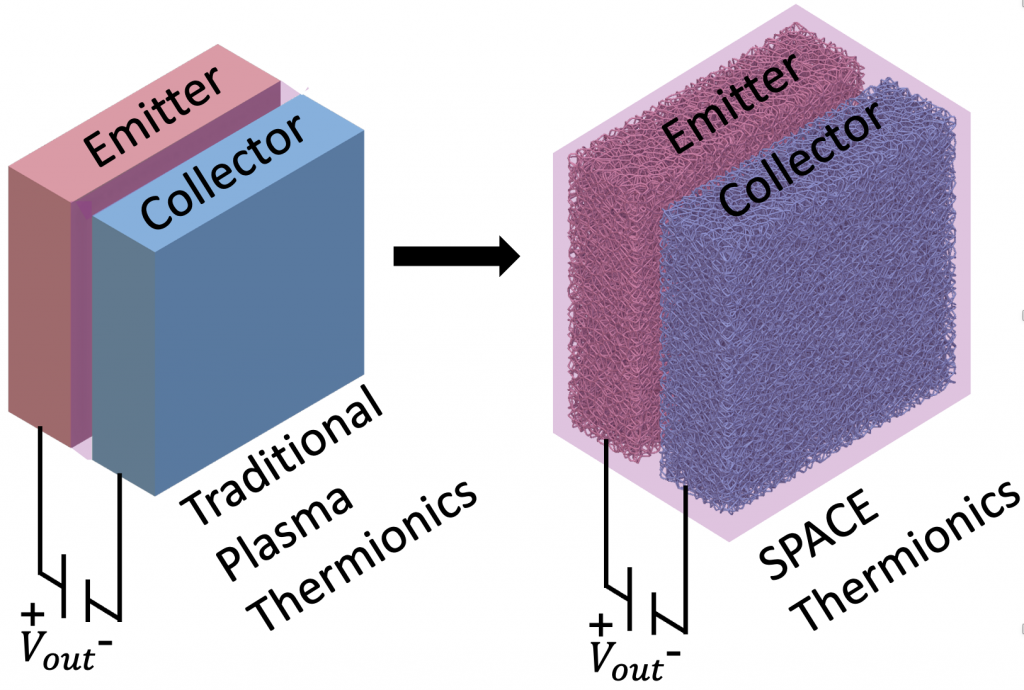
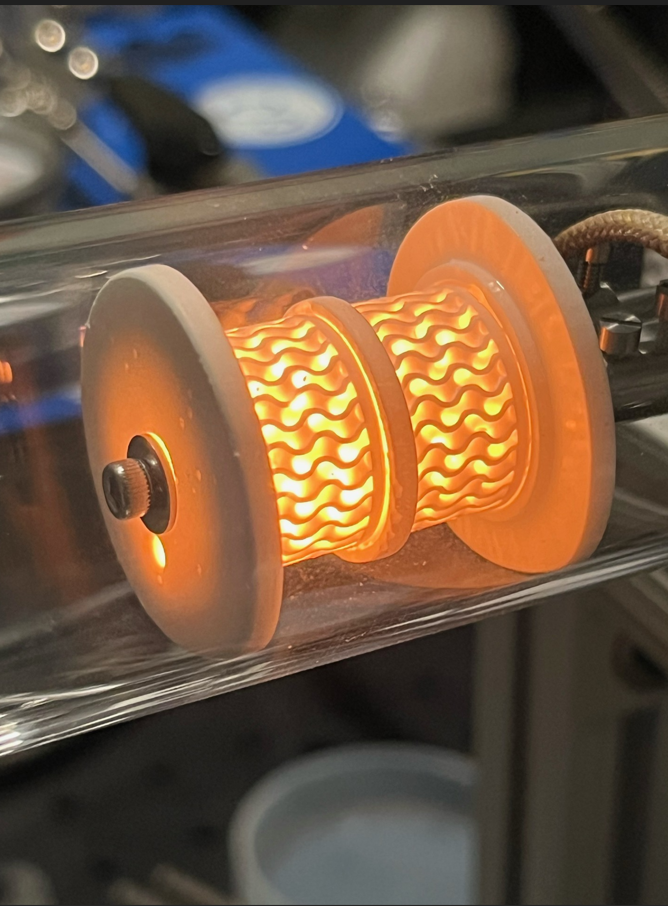
Thermionic energy conversion (TEC) is a method of converting heat into electricity without any moving parts. “TEC involves heating up a special ‘emitter’ metal to very high temperatures, at which point it begins to lose electrons,” explains Austin. “These electrons travel across a very small gap to a ‘collector’ metal, creating an electrical current.”
In principle, this process works well, but in practice, it has some major efficiency limitations. For example, as electrons are released, they can build up around the surface of the emitter, creating an electric field that blocks any further electrons from being emitted. “This is known as the space-charge effect, and most current thermionic energy converters counteract it using a low-temperature plasma to help conduct the flow of electrons between the emitter and collector,” explains Austin. “Most designs create this plasma using the energy from the emitted electrons, which means there’s much less energy available to be converted to electricity.” Given the extremely high temperatures involved, further energy is lost as heat radiation. Current TEC systems have a typical efficiency of below 7%, and have few applications beyond research laboratories.
SPACE-TEC: uniting nuclear radiation and thermionic energy conversion
Austin’s ground-breaking project, SPACE-TEC, employs innovative solutions to address these inefficiencies. In particular, SPACE-TEC uses nuclear radiation to heat the emitter and create the low-temperature plasma needed for TEC to operate. While other nuclear-based TEC systems also use nuclear radiation as a heat source, they still rely on energy from emitted electrons to create the plasma.
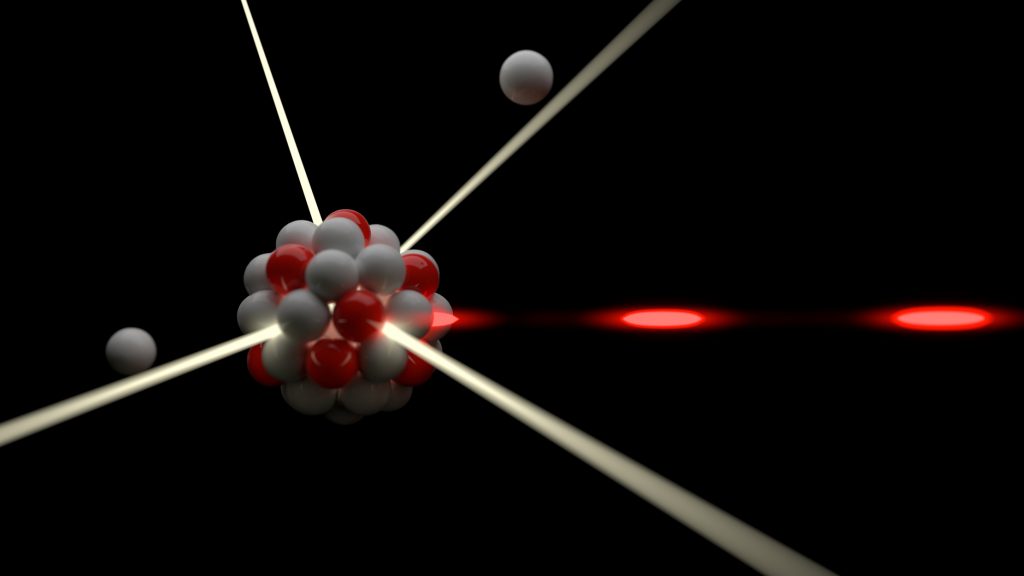
“In contrast, the highly-pressurised gases used in SPACE-TEC create an environment in which the nuclear radiation naturally knocks electrons off atoms in the emitter, collector and other structural components, creating the low-temperature plasma,” says Austin. “This means that more energy is available to be received by the collector, rather than being used to create the plasma.”
SPACE-TEC also uses specialised metal foams as the emitter and collector. These are essentially highly-porous metal ‘sponges’, full of tiny holes and channels that give them a huge overall surface area. “This means more places for electrons to escape from the emitter, travel through the plasma, and be collected at the collector,” says Austin.
Metal foams also help address the issue of heat loss. In a conventional TEC system, heat is lost through the emission of photons, which radiate out of the system. However, in SPACE-TEC, photons have a much higher chance of being reabsorbed thanks to the high surface area of the porous metal foam. This means that the system can operate efficiently at lower temperatures.
Nuclear-powered futures: even the sky’s not the limit
The qualities of SPACE-TEC technology give it a range of exciting applications. “SPACE-TEC could make nuclear power plants much smaller, simpler and cheaper,” says Austin. “Since it doesn’t involve big turbines and complicated equipment, we can build power systems that are easier to transport and quicker to set up.” This could make nuclear power a much more practical, efficient and economical option for the clean energy transition – not to mention a viable means of exploring the final frontier. “In space, it’s ideal to have a lightweight, compact power source with no moving parts,” explains Austin. “Our system could help power future space stations, rovers, or even settlements on the Moon or Mars.”
But before these applications can become reality, Austin needs to test and refine the technology. “We’re currently testing the system in a research nuclear reactor,” says Austin. “Our next steps include improving the materials, making the system more efficient, and running longer tests to make sure it’s safe and reliable. After that, we’ll work on scaling it up and designing versions for different uses – both on Earth and in space.”
 Dr Austin Lo
Chief Research Officer, GenAlpha Nuclear Technologies, USA
Fields of research: Nuclear engineering, thermionic energy conversion, low-temperature plasma physics
Research project: SPACE-TEC (Structured Plasma Cell- Thermionic Energy Conversion): developing a groundbreaking nuclear fuel technology that can directly convert nuclear heat into electricity
Funder: US Advanced Research Projects Agency – Energy (ARPA-E)
The contents are solely the responsibility of the authors and do not necessarily represent the official views of ARPA-E.
Reference
https://doi.org/10.33424/FUTURUM652

© Contentino/Shutterstock.com
© TonyV3112/Shutterstock.com

About nuclear engineering
Nuclear engineering involves finding innovative methods of harnessing the energy released by nuclear reactions. Much of this work occurs at the cutting-edge of our knowledge and capabilities. “Nuclear engineering is at the forefront of solving some of the world’s biggest challenges, such as providing clean energy, enabling space exploration and advancing medical technologies,” says Austin. “Whilst conducting the first experiment to test one of these concepts, I thought, ‘I might actually be the first person in the world to do this.’ It is incredibly rewarding to work on brand new ideas that nobody has tried before, but it doesn’t come with an instruction manual – you have to figure it out as you go.”
Making mistakes and learning from them is a necessary and indispensable part of such research. “Trust me, you won’t get it right the first time – nor the second, nor the third,” says Austin. “Be willing to try, fail and try again.” This takes resilience and perseverance, but will ultimately pay off. “Another challenging, but also rewarding, factor is that nobody is going to make you do the work,” says Austin. “You have to be your own biggest motivator.”
The field of nuclear engineering involves a lot of collaboration across disciplines. “My research combines nuclear science, materials engineering, plasma physics and advanced manufacturing,” says Austin. “No one person can master all these areas, so working with experts from different fields is essential.”
The future of nuclear engineering is very bright, with many sectors just beginning to consider how nuclear energy could bring revolution. “There will soon be exciting opportunities to design advanced reactors, develop new radiation therapies and explore innovative ways to generate energy,” says Austin. “The field is growing quickly, so now is a great time to get involved!”
Pathway from school to nuclear engineering
Austin says that studying mathematics and physics in high school is essential. Other complementary subjects include computer science, chemistry and biology, as well as humanities subjects that build world knowledge and communication skills.
At university, Austin recommends looking for courses in nuclear engineering, mechanical engineering or physics.
“Look for opportunities to get involved early,” says Austin. “Try for internships, even if they aren’t directly in nuclear engineering – anything that gives you hands-on experience solving problems will help you build useful skills.”
Explore careers in nuclear engineering
As well as academic careers, there are a range of career options in nuclear engineering in sectors such as energy, defence, space and healthcare. This page from RaiseMe gives an idea of roles and responsibilities.
The Pathways to Science website provides a great directory of US-based summer camps, internships and activities in the field of chemical and nuclear engineering, including opportunities for high school students.
DanFusion provides a list of plasma physics summer schools based in Europe.
Meet Austin
As a teenager, I was mostly focused on learning classical piano and playing tennis. While I was good at math and science, they weren’t really my passions. That changed in my senior year of high school, when a physics class completely shifted my perspective: suddenly, math wasn’t just abstract number puzzles, but a way to understand how the world works.
Nuclear energy has incredible power. Every nuclear reaction releases or absorbs about a million times more energy than a typical chemical reaction. The possibilities of what we could do with that energy are limitless. There is still so much we don’t know, and so much potential to discover and apply.
Curiosity, creativity and persistence are essential in my field. I’ve learned to ask tough questions, to stick with ideas that show promise and to walk away from ones that don’t. Also, doing what I’m not ‘supposed’ to do has been the key to my biggest innovations. I love being able to run the show and make my own decisions.
I always try to be honest with myself and with others, even if it’s uncomfortable. People can tell when you’re being real, and they respect that. And although you might be able to get pretty far on your own, it’s your collaborators, mentors and teammates who help you over the finish line every time.
Outside of work, I’m a very active person! I love tennis, pickleball, boating, rock climbing and jetboarding – which is riding on a jet-propelled surfboard!
Austin’s top tip
Nuclear engineering has a lot of different career paths. Don’t lock yourself into one too early. Explore different areas, try new things and don’t stress if it feels like you’re jumping around or moving slower than others. The variety will make you more adaptable and well-rounded in the long run.
Do you have a question for Austin?
Write it in the comments box below and he will get back to you. (Remember, researchers are very busy people, so you may have to wait a few days.)
2 Comments
Submit a Comment
Learn more about the wonderful world of nuclear physics:
futurumcareers.com/can-we-unlock-the-secrets-hidden-deep-within-the-nucleus-of-an-atom
As you mentioned how your interest in Science and maths suddenly just increased in a shorter duration suddenly ,so what do you think what actually make that happen cause you were not really interested when you were younger but with time and maturity when you just grow up , you suddenly get interested into maths and science is there any stimuli at that time responsible for that action?
Laya,
That’s a great question! don’t think my interest in science suddenly appeared out of nowhere. It was more that “something” clicked at the right time.
For me, the biggest change came from being in the right classes at the same time. When I was 17, I took my first physics course while also learning calculus. Together, those subjects gave me a powerful new way to understand things I already cared about. Physics and math suddenly explained my everyday experiences: why a tennis ball curves through the air, or why pressing a piano key softly versus forcefully changes the sound. And so much more!
Before that, most of my science classes were biology and chemistry, which felt more abstract and unrelatable to me. And my math was mostly about solving equations for x, y, and z without much connection to real life. The combination of Physics and Calculus showed me that the things I learned in school could be used for exploring the rest of the world, not just random things in the classroom.
So I’d say the “stimulus” was discovering a new way to understand things I already loved. Once learning connects to the world you’re curious about, it can completely change how interesting it feels. From there, the curiosity tends to grow and take you to places you could never imagine before!