
Sharing a passion for STEM around the world
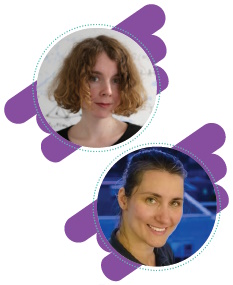
Lecturers Without Borders (LeWiBo) is a non-profit organisation that bridges the gap between the global research community and school classrooms. The initiative encourages scientists who are already travelling for work to visit local schools, providing students with first-hand exposure to various STEM fields through interactive experiments. Founders Dr Liubov Tupikina and Dr Athanasia Nikolaou tell us more…
 Why did you set up Lecturers Without Borders?
Liubov: The motivation came from a personal realisation following the defence of my PhD thesis. After all the hard work, I realised that no one was going to approach me to ask about my research; if I wanted to share my work with a wider audience, I had to be proactive. Establishing Lecturers Without Borders (LeWiBo) was my way of opening up this possibility, not just for myself, but for other researchers and professionals who found themselves in the same situation. Ultimately, I see LeWiBo as a platform for sharing what you are passionate about with the world.
What are LeWiBo’s goals?
Athanasia (Nasia): Our overarching aim is to bring science and scientists directly into classrooms, both online and offline, to empower, inspire and motivate children and teenagers. We strive to provide a safe, inclusive environment for genuine dialogue between professional scientists, educators and students. On a broader level, we want to encourage a permanent relationship between the scientific community and the public. We believe in providing students with first-hand experiences of what science is and who scientists are, while giving a voice to minorities in STEM and ensuring science engagement opportunities for everyone.
How does LeWiBo engage with schools around the world?
N: Our main strategy revolves around the fact that researchers often travel for work. We leverage this by connecting scientists with schools in the regions they are visiting. We also facilitate connections through international conferences and partnerships with various organisations. Our vision for LeWiBo is to move beyond simple, one-off personal connections and toward long-term sustainable programmes. We want researchers to engage with schools to create lasting educational impact.

L: We are aware that teachers are under huge stress and often lack the time to organise extracurricular activities. Because of this, we try to make it as easy as possible for them to engage with us. They can subscribe through a form on lewibo.org, and we will then reach out to them when any scientists are travelling nearby.
Our goal is to facilitate participation that is low-effort for the educator but high-impact for the students. By building sustainable activities, we can attract more researchers to the network without adding to the administrative burden on schools.
What does the LeWiBo network look like?
N: We have a main group of approximately 500 registered scientists. Because LeWiBo is a non-profit, all our lectures are provided free of charge, and we operate in a sustainable, self-operating manner. The number of scientists actively participating at any given moment fluctuates depending on the season, when people are travelling, or when major conferences are being held.
What is a typical LeWiBo experience for a student?
L: Although we do run webinars, offline and on-site events are an important part of what we do. For example, we have had researchers from France who travel to schools in Nepal to give lectures in person. Typically, a researcher arrives in the classroom and provides an overview of their work. But we also encourage them to focus on their ‘passion subjects’ – the topics they are most interested in explaining.
N: The main aim is to engage students. We don’t just lecture on a requested curriculum topic; we bring something that sparks immediate curiosity, such as using metaphors to refer to exoplanets with exotic climates for elusive magma oceans (e.g., ‘dragons in the sky’) or setting up an ant colony experiment.
What student age groups do you work with?
N: We work with a very wide range of ages. Generally, we start with students around the age of 10, although we have organised events for children as young as seven. Our reach extends all the way up to the master’s level in colleges and universities, meaning we work with students up to 30 years old.
What have been the challenges of making LeWiBo a success?
L: One of the most significant challenges is grabbing and maintaining students’ attention, particularly with the older generation. Younger students are often easier to engage. When a scientist arrives from another country, their presence is already different and exciting.
To ensure the lectures are successful – including for older students – we provide specific training for scientists and collaborate closely with teachers. This collaboration helps the scientist understand the specific audience and the cultural context of the school.
What impact has LeWiBo had?
N: We have an extensive network of schools. Before the COVID-19 pandemic, we were working with about 100 schools, but that jumped to almost 300 schools within a single year as we moved to webinars. While these numbers are impressive, we try to ensure that the quantity of schools is not our only metric. What truly matters to us is the number of participating researchers and engaged students. We attempt to collect feedback from schools to monitor this impact, though collecting data remains a difficult task.
L: We work all over the world, but we often find that schools in under-resourced areas or certain countries are easier to connect with because they are so open to welcoming scientists. However, we have had very interesting and successful experiences in many places, including Nepal, India, Germany and the UK. Schools have been very welcoming.
What has been a highlight for you during these school visits?
L: For me, and I think for many of our lecturers, a major highlight is the realisation that explaining your work to students changes your own relationship with the subject; it provides a fresh perspective on it. When you have to break down complex concepts for a young audience, you often start to understand aspects of your own work that you hadn’t fully grasped before. It’s a very important aspect of personal development that I try to pursue.
One specific moment that made me very happy was when I explained a mathematical problem – the kind usually reserved for PhD students – to a 5th grade class, and they provided original and insightful responses! This kind of outreach provides a sense of enjoyment and satisfaction that allows you to see your own subject in a completely new light.
How can teachers or scientists get involved?
N: We have made the process very simple for teachers because we want to be as accessible as possible. Apart from telling us your available time and the current curriculum topics you are working on, we don’t require much else. We take the information about the students’ ages and the topics and do the work of matching teachers with a scientist.
L: For scientists, the process is also straightforward – you simply need to register on our website. The ‘tricky’ part is that you must remember to tell us when you are travelling! So, we need to know you want to be part of the network and your travel schedule. We then provide hints on schools you can visit or teachers you can meet at your destination. Because we do not fund travel, we rely on researchers who are already going somewhere for work and want to make the most of their time there.
What’s next for LeWiBo in the coming years?
N: Our next steps are focused more on depth than breadth. While we are always open to growing the number of scientists and schools, we want to connect more deeply with the people already in our network. We are planning ‘meet and greet’ sessions for our scientists and encouraging schools that have already participated to provide feedback and collaborate on creating sustained, long-term programmes.
L: LeWiBo is a collective effort, with many colleagues working to create new and valuable experiences for educational institutions, as well as for scientists. We’ll keep building and sharing this experience together, as open and free education is precious in this fast-changing world.
Meet Liubov
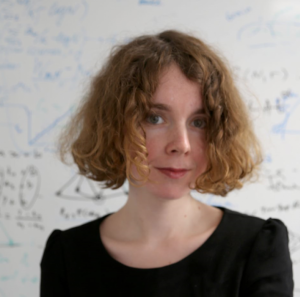 Dr Liubov Tupikina is a mathematician, working on stochastic processes and applications with research groups in France, Germany and Russia.
My interest in STEM was sparked by my school mathematics teachers, Alexander Ivanishcuk and Helen Bunina. If not for them, I would not be where I am now. They made me start to like physics first, and that led me to an interest in mathematics. I wouldn’t say I started by loving mathematics, rather, I became interested in other disciplines and mathematics was the necessary language for these disciplines. Other scientists have always inspired and led me to stay engaged with what I loved.
While many scientists might point to their PhD as their greatest achievement, I particularly enjoy working in interdisciplinary research problems, translating one language to another, as well as supervising and co-supervising students. Growing a network of young researchers around you is invaluable, and those connections and collaborations matter to me more than personal accolades. I am happy about the achievements of my students and collaborators with whom we are participating in research. And, of course, we are proud of Lecturers Without Borders!
Liubov’s top tip
Love what you do, but don’t stop there. You must also strive to deeply understand why you like it. Never stop questioning that motivation. If you maintain that constant inquiry, you can stay open to new ideas and ensure you never lose your path.
Meet Nasia
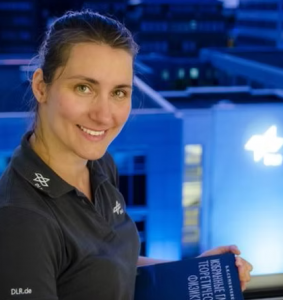 Dr Athanasia Nikolaou is a physicist and has been a member of the international science consortium of the ARIEL Space mission. She works as a contractor for the European Space Agency (ESA) in Italy.
My ‘love at first sight’ moment in science was receiving a kids’ chemistry set when I was 10. I was very happy meticulously weighing substances and making colours change in solutions. At first, I was driven by beauty and was avoiding drilling into maths equations, but when I read an article about a Greek mathematician who was discovering equations that described irregular crystals, my imagination was captured! An equation that showed a pattern that isn’t repetitive? I realised maths can be cool!
My father has always encouraged me to follow science, even when I was reluctant about my own skills in maths as a teenager. Luckily, he could see beyond the terror imposed by secondary education mathematics teachers at the time!
My career has been shaped by many experiences. At university, I had a professor of astrophysics whose door was always open for questions. A poster of a space mission that I got from him is still up in my room. Being accepted for a young graduate trainee position at the European Space Agency at the end of my master’s degree and earning a place in the Advanced Concepts Team of the agency were pivotal. Since then, I discard no idea as too crazy or unfeasible, which has shaped my approach to science and teamwork.
I am proud of publishing my first paper in the journal Climate Dynamics. I highly respect the science published there. I am also proud that I was invited to NASA Goddard in the US to give a talk with other planetary scientists as an expert on magma oceans. The principal investigator of ESA’s ARIEL mission, Professor Giovanna Tinetti, has trusted me and other scientists to write a chapter about rocky exoplanets and, thus, contribute to the red book of the mission. I feel honoured to have added a pebble in this giant effort of discovering worlds beyond ours.
Nasia’s top tip
Ask about something but don’t be reassured unless you have reproduced the proof yourself. As with almost in everything else in life, the devil is in the details that are silenced.
 facebook.com/Lecturerswithoutborders
 linkedin.com/company/lewibo

Do you have a question for Nasia and Liubov?

Scientix® is a platform containing educational science resources for teachers:
www.futurumcareers.com/attention-teachers-scientix-a-platform-packed-with-science-focused-services
0 Comments