
Transforming college mathematics education through hands-on modelling experiences
STEM students start college hoping to build purpose for their lives and valuable skills for their careers. These students desire to find meaningful answers to questions like, “How does what I learn in school apply to problems I want to solve?” and “How does this relate to the future I want to create?” However, many college STEM courses do not prepare students for a career in their chosen field and focus on content that is far removed from students’ lives. This is why, at Foothill Community College in California, USA, Professor Jeff Anderson is developing an open-access learning curriculum alongside hands-on mathematical activities and laboratory equipment to create rich applied learning experiences for his students.
Talk like an applied mathematician
Applied mathematics — the process of using mathematical methods to solve practical problems in other fields like engineering, science, medicine and finance
Linear algebra — a subfield of mathematics that is commonly used to model, analyse and improve solutions to real-world problems
Mathematical modelling — using mathematics to represent, analyse, make predictions about or otherwise provide insight into authentic problems related to real-world phenomena
STEM — science, technology, engineering and mathematics
In the US, less than half of college students graduate within the first 4 years of their degree. This staggering statistic raises a difficult question: if airline companies designed planes that killed half of their passengers, would anyone buy a ticket? Yet in higher education, such outcomes are accepted as normal.
Dr Jeff Anderson, a mathematics educator at Foothill Community College, refuses to accept this status quo and has dedicated his career to transforming college STEM education. “I focus on designing engaging classroom experiences that empower students to build transferable skills that they can use to transform their world, build their dreams and ignite their careers,” says Jeff. “I believe that the best way to do this is to put students to work using hands-on learning experiences that are directly related to their academic and career interests.”
The problem with traditional STEM education
Instead of igniting students’ interest and excitement, college STEM classes often leave students feeling disengaged, discouraged and uncertain about how course content is relevant to their lives, career goals and their wider world. “College math textbooks often present a long list of definitions, theorems and examples without demonstrating how that math can be applied in the world to solve meaningful problems,” says Jeff. “I believe we can and should do better. When students show up to class, they are looking for purpose, inspiration and hope for the future.”
“In addition to these problems with traditional classes, many professors do not explicitly help their students learn how to learn,” continues Jeff. “This is a huge mistake. One of the best things I can do for my students is to teach them how to be more sophisticated learners. While most linear algebra teachers believe our job is to teach linear algebra, I disagree. I believe that I teach students how to learn, and I do this using linear algebra!”
How can linear algebra help?
Most students first encounter linear algebra when using equations such as y = mx + c to plot straight lines on a graph. This relationship is foundational and underlies an important idea: many complex systems can be modelled using linear algebra. Linear algebraic tools are central in applied mathematics for transforming real-world problems into mathematical models that can be used to find meaningful insights and develop possible solutions. Using these methods, a problem that might have taken huge amounts of time and money to prototype can be turned into a simulation.
For example, early aeronautical engineers built physical aeroplane prototypes and pushed them off cliffs, only to watch years of their lives and piles of their money go up in flames. Although this process eventually led to success, it was very costly. Starting in the 1980s, airline companies began using mathematical models to simulate plane designs and improve their engineering methods, saving a lot of time and money.
Unfortunately, college STEM courses often do not teach these types of applied modelling processes. Well-designed, hands-on mathematical modelling experiences allow students to apply their knowledge directly towards solving problems they believe are meaningful. Thankfully, Jeff is pioneering novel, open-access learning resources that put students in the driver’s seat.
The LANA project
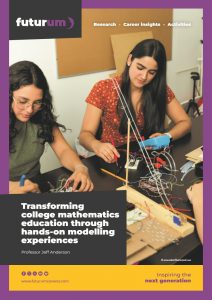
“When I designed the Linear Algebraic Nodal Analysis (LANA) project, I focused on building learning experiences in which students participate in the entire mathematical modelling process,” says Jeff. “I want to give students authentic modelling experiences that mirror what they might do as professionals after they graduate from college.” LANA is a hands-on modelling project in which college students gain experience in both electrical engineering and applied mathematics.
Professional electrical engineers design circuits using mathematical models that simulate a circuit’s behaviour. “This process saves them time and money because they can improve their design before manufacturing physical prototypes for testing,” explains Jeff.
Reference
https://doi.org/10.33424/FUTURUM682
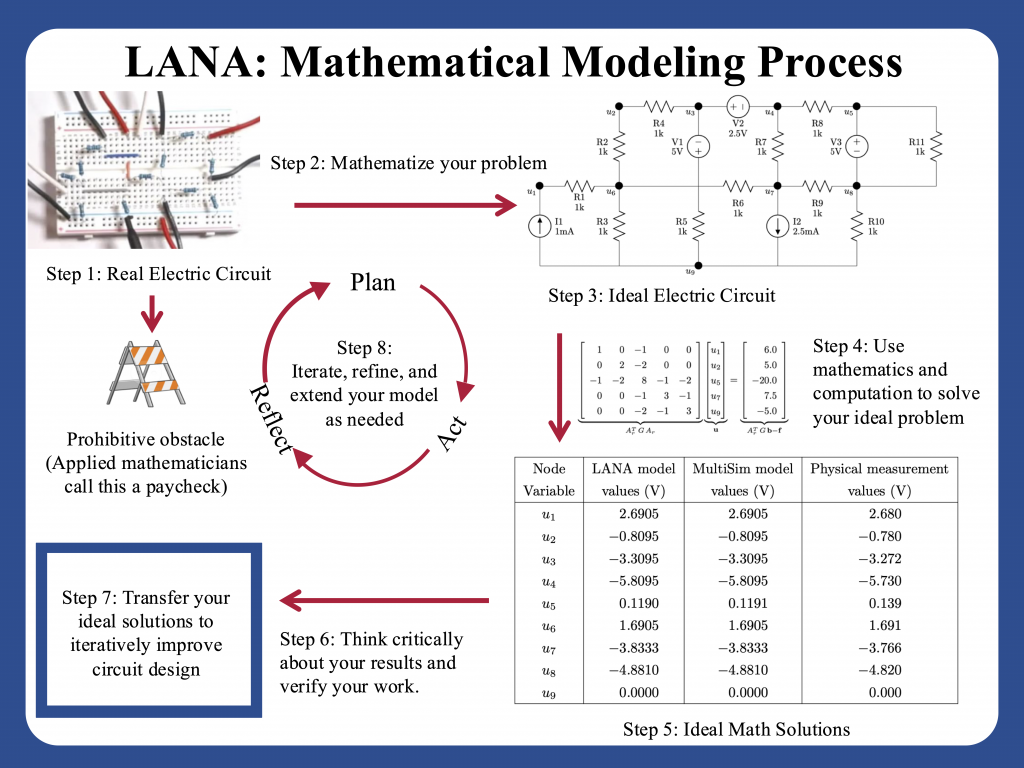

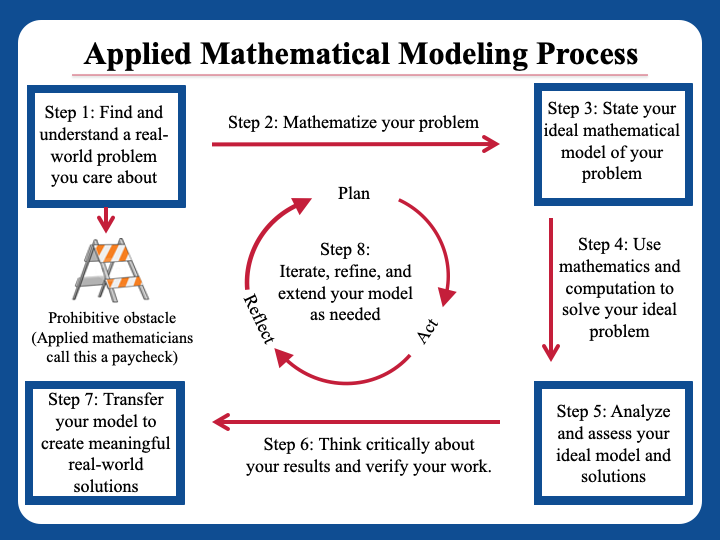
The LANA project simulates this reality by allowing students to create mathematical models of electrical circuits. To verify their models, Jeff expects students to build and test physical prototypes of their circuits. “Unfortunately, testing a circuit traditionally involves using a bench power supply, which can cost up to $500,” says Jeff. “So, as part of my effort to develop the LANA project, I worked with an expert engineering team, including two students, to create something that we call a power block, or P-block for short.”
P-blocks are inexpensive power supplies that enable students to test circuit behaviour anywhere they want, even at their own kitchen table. “The goal of the P-blocks project is to make it easy for students to build physical prototypes of their circuits and check the accuracy of their mathematical models for themselves,” explains Jeff. “This means that students no longer need to depend on a teacher to check their work. Instead, they can check their own work by building their circuits, testing the values and comparing their measured data against the mathematical results they produce in their modelling process.”
Power to the students
One of Jeff’s students, Natalie Thiel, spent over fifty hours working on the LANA project, and this experience gave her the confidence to apply for her first paid engineering job. After Natalie’s successful interview, Jeff received a call from her new manager, asking if he could hire more students who had gone through this type of training.
Another Foothill alumnus, Nick Litvinov, completed the LANA project and later told Jeff that, “It was the most meaningful and memorable experience I had in any of my undergraduate classes.” Considering that Nick went on to attend one of the highest-ranked universities in the US, this praise speaks volumes about Jeff’s revolutionary teaching practices.
“When students are diligent in this work, they begin to develop a large collection of transferable skills including the ability to make connections between their math classes and their target fields of study,” says Jeff. “I love helping students discover that they can use mathematical thinking to improve their world, build their dreams and help the people they love.”
 Professor Jeff Anderson
Department of Mathematics, Foothill Community College, Los Altos Hills, California, USA
Fields of research: Applied mathematics education; numerical linear algebra
Research project: Developing a hands-on, open-access, applied linear algebra curriculum alongside accessible mathematical models and inexpensive laboratory resources to help students build transferable skills while falling in love with applied mathematics
Funders: Patreon community; YouTube revenue; private donors; self-funded
Website: youtube.com/@JeffAndersonMath
About applied mathematics
Linear algebra is to mathematical modelling what oxygen is to the human body – essential. It provides us with the mathematical language to model, analyse and improve solutions to real-world problems, and without it, the field of applied mathematics simply would not work.
The engineers, mathematicians and scientists who built the first digital computers did so with the goal of accurately simulating the physical world using mathematical models. “The first computers were paid for by the US military during World War II to simulate atomic bomb shockwaves and calculate the trajectories of missiles fired at Nazis,” says Jeff. “However, once they were finished with their bombs and missiles, scientists soon realised that these techniques could be applied across many areas of knowledge. Scientists from different fields used them to model the motion of planets, design rockets, develop new medicines, design buildings and bridges, build social networks, and much more.”
The vast scope of applied mathematics means that students can make use of it, whatever their interests. “I believe that learners who take mathematics seriously can use their skills to transform the world and realise their dreams,” says Jeff. “Mathematical modelling is like a muscle. For a muscle to be strong, we must train and exercise it often. However, it is also true that once we have strong muscles, we must make conscious choices to use our strength in service of other goals we have.”
One question that Jeff likes to ask his students is, “How can you use your mathematical modelling skills to build a better world that aligns with your deepest values?” The answer to this question lies in your own interests, dreams and ambitions. “A fun byproduct of this reality is that we can also earn a living from our ability to create models,” says Jeff. “In other words, we can use mathematical models to improve human life while also generating income that can pay for our rent, food and other things we need to live.”
Pathway from school to applied mathematics
At school, build a solid foundation in mathematics. At the same time, continue to pursue other interests, as you may be able to combine them with your mathematics skills and knowledge.
Jeff recommends learning how to read and do mathematical proofs, and how to solve problems. These books can help you get started:
- Book of Proof by Richard Hammack
- How to Read and Do Proofs by Daniel Solow
- How to Solve It: A System of Thinking That Can Help You Solve Any Problem by George Pólya
- Thinking Mathematically by John Mason
“Once you know how to read and do proofs and solve problems, you can teach yourself any math that has ever been written on any subject,” says Jeff. “You can create new solutions to problems that have never been solved. By developing those two skills, you will be able to teach yourself as much linear algebra as your heart desires.”
Explore careers in applied mathematics
“The trick of applied mathematics is to create mathematical models that describe problems in your life that you care about solving and to believe you can make an impact in your world,” advises Jeff. “If you do that well, I believe you can transform the world and collect a pay cheque at the same time!”
Explore this careers brochure from The Society for Industrial and Applied Mathematics.
To help students explore the connections between applied linear algebra and mathematical modelling in STEM, Jeff is developing a free Applied Linear Algebra Fundamentals textbook.
Meet Jeff
From the age of 10 to 14, I survived intense bullying and even received a concussion after being body slammed at school. Post recovery, I started martial arts. By age 23, I had earned black belts in jujitsu and judo. I also won national tournaments and got my amateur boxing licence. During my decade on the mat, I strengthened my body, practised high levels of self-discipline and learned to face my fears.
When making big decisions, I like to imagine the future. I saw that many older warriors had unstable careers, broken bodies and damaged brains. In contrast, older mathematicians had healthy bodies, sharp minds and stable jobs. These mathematicians also practised mental toughness. However, instead of using violence, they used their intellect. I saw that, when done skilfully, we can use mathematical reasoning to help create a better world.
The game of research academia devalues great teaching. College professors are incentivised to do research, win grants, compete for prestigious awards and earn lucrative textbook contracts at the expense of time spent with students. During my mathematics education, several professors told me: “You are stupid,” “You do not belong here,” “You will never be good at math,” “You ask too many questions,” “Please just do what I say.” However, I know how to protect myself. When professors tried to weed me out, I stood my ground. I showed up. I made these people work. And I promised myself I would do better for my students!
I dedicate my career to the next generations. I want to be part of and help grow a community of educators who shift the culture of college STEM education away from our harmful status quo by transforming teaching policies and practices. I want to help create a world in which students learn deeply, feel inspired and build valuable transferable skills in college classes that feature 100% success rates. This problem is quite hard.
I take lots of pride in making memories with people I love and caring for my health. I have two sons and often say to them, “Being your dad is the best thing I have ever done with my life.” I also love to spend time with my amazing wife. In my free time, I enjoy running, exercising, physical training and going for hikes in nature.
Jeff’s top tips
1. Learn how to read. If you can read deeply, you can teach yourself anything you want to learn, including mathematics. I love a quote I learned from the amazing educator Harriet Bell: “Reading is knowledge. Knowledge is power. Power is money.” When students ask me how to make money, my response is always: learn to read!
2. Remember that you are the world’s leading expert on your own learning. You know more about yourself, your dreams and your experiences than any teacher ever will.
3. The future is unwritten, so you can play an active role in creating a new world. As you do so, think for yourself. Ask questions. Show up and force teachers, experts and authority figures to work for you and to help you build the types of learning you want to create.
This article was written by Duy Nguyen, a 4th-year undergraduate Electrical Engineering student working with Jeff at Foothill Community College.
Do you have a question for Jeff?
Write it in the comments box below and he will get back to you. (Remember, researchers are very busy people, so you may have to wait a few days.)
Discover how mathematical models can be used in wildlife management and conservation:
futurumcareers.com/how-are-mathematical-models-helping-wildlife-management
0 Comments