
Zero Project – for a world with zero barriers
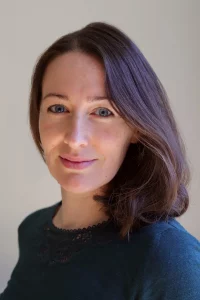
Judith Hermetter, Global Head of Communications at Zero Project, tells us about the global and research-driven initiative that finds and shares solutions that improve the daily lives of people living with disabilities
 When and why was Zero Project formed?
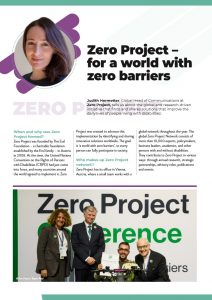
Zero Project was founded by The Essl Foundation – a charitable foundation established by the Essl family – in Austria in 2008. At the time, the United Nations Convention on the Rights of Persons with Disabilities (CRPD) had just come into force, and many countries around the world agreed to implement it. Zero Project was created to advance this implementation by identifying and sharing innovative solutions worldwide. The goal is ‘a world with zero barriers’, so every person can fully participate in society.
Who makes up Zero Project network?
Zero Project has its office in Vienna, Austria, where a small team works with a global network throughout the year. The global Zero Project Network consists of more than 10,000 experts, policymakers, business leaders, academics, and other persons with and without disabilities. They contribute to Zero Project in various ways: through annual research, strategic partnerships, advisory roles, publications and events.
What connects the different solutions being developed around the world?
Everyone who takes part in Zero Project’s research and initiatives does so with the intention to collaborate and learn from each other. It is for all people, sectors of society, countries and types of disabilities. Consequently, there is a large diversity of innovations among the awardees. However, since the barriers persons with disabilities face are often similar, the same solutions may apply – perhaps with some adaptations to fit the local context.
Here are just a few examples:
Mobility/Employment:
Social enterprise Neomotion, from India, developed an attachment for wheelchairs so users can work as delivery drivers and run their own businesses. Similarly, this year’s awardee, Matt Movilidad, from Colombia, created a low-cost wheelchair attachment using bicycle parts, enabling wheelchair users to work as local guides.
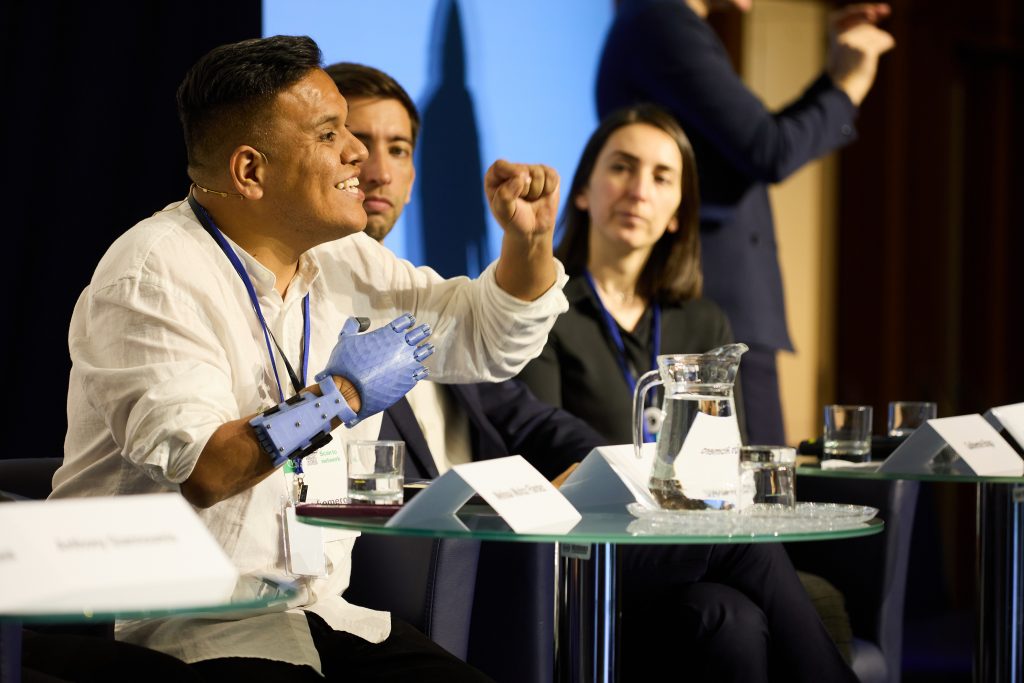
© Zero Project / Rupert Pessl
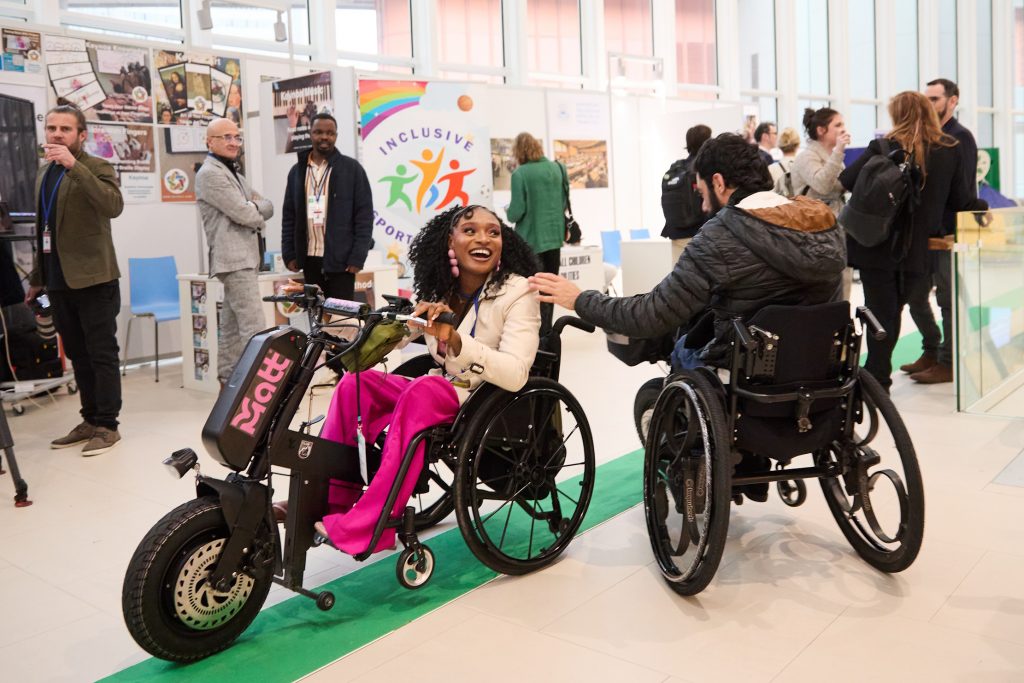
© Zero Project / Rupert Pessl

Emergency services:
TapSOS (UK) and AccessSOS (US) are apps that allow persons with disabilities to contact emergency services without making a phone call. This is critical for people who are deaf or non-verbal, but the technology is also useful for the elderly or individuals who have had a stroke and cannot speak. Both apps integrate with their respective national emergency services.
To be effective, an innovation must be co-designed with or led by persons with disabilities. The famous quote, “nothing about us without us”, ensures that individuals who truly understand the barriers are involved from the beginning.
How are Zero Project awardees chosen?
Once a year, the Zero Project Network reaches out to all corners of the world during a ‘Call for Nominations’ for the Zero Project Awards. Last year, 586 nominations from 93 countries were submitted thanks to this collective effort. Nominations can include products, services, public policies and other types of initiatives. All types of organisations can nominate – from small grassroots initiatives and startups to large corporations, non-government organisations (NGOs) and public sector bodies.
Each year, the Call for Nominations addresses a specific topic, such as accessibility, education, employment, independent living or political participation. Information and communication technology (ICT) is addressed every year due to its significance for disability inclusion, and there is also a special focus on inclusive arts.
To be successful in the selection process, each nomination must meet three main criteria: innovation, impact and scalability. In a months-long selection process that involves the global network, each nomination is fact-checked, evaluated and peer-reviewed. More than 400 experts contributed last year. From the original pool of nominations, around 75 innovative solutions are selected for a Zero Project Award every year. Awardees receive support from the global network and present their work at the annual Zero Project Conference at the United Nations Office in Vienna.
What were the highlights of this year’s conference?
The Zero Project Conference 2026 (#ZeroCon26) was held in February, with more than 1,400 participants, with and without disabilities, and without disabilities from around 100 countries attending.
The highlight is the Award Ceremony, where the Zero Project Awardees receive their official certificates and their work is celebrated by the global community. However, personal highlights differ for every participant: for some, it’s the opportunity to pitch their work to potential partners; for others, it’s learning from experts or discussing opportunities to scale their solutions.
What makes Zero Project conferences unique worldwide is the focus on community-selected innovations that can be replicated. Participants also often describe a unique energy at the event, as every person attends in a spirit of collaboration. As the organisers, we do our best to make the event as accessible as possible, for instance, through tactile flooring, International Sign interpretation in sessions and a quiet room.
What impact is Zero Project having?
Zero Project is always an enabler or platform to share and amplify the work of others. As such, the impact is not always immediate, and it varies. We know that Zero Project events have sparked new partnerships around the world. Through publications and media-related efforts, little-known initiatives receive visibility. Some awardees receive increased support in their countries because of the Zero Project Award’s international reputation. Others gain access to important stakeholders, such as policymakers, while some improve their products by learning from the community.
For many, it’s also very encouraging to see that they are not alone in their work for disability inclusion. Being at the Zero Project Conference and having this sense of belonging to a community is also a big motivational boost for those of us on the team.
What does the future hold for Zero Project?
It’s a difficult time for diversity, equity and inclusion (DEI) initiatives around the world, and there are multiple crises – such as conflicts and the climate crisis – where persons with disabilities are among the most vulnerable groups. It is not an easy time for this community, but Zero Project is here to stay and will continue to provide a global platform for disability innovation. We are in the privileged position of seeing innovative approaches and solution-oriented thinking across our global community every day, so while barriers are real, we know that the work towards a world with zero barriers continues – and it is powerful.
Removing educational barriers
Here are just a few recipients of Zero Project Awards 2026:
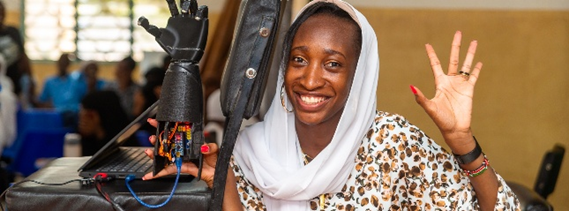
Solution: Zerobionic Robotic Hand
Organisation: Zerobionic
Country of implementation: Kenya
Zerobionic, headquartered in Nairobi, is an ICT start-up focusing on inclusive educational technology, the core project of which is a robotic hand using AI to translate classroom STEM (science, technology, engineering and mathematics)
content into real-time sign language. Launched in 2022, Zerobionic has grown through partnerships and international replication, reaching over 500,000 students in 120 African schools and 9,500 students in four Swiss schools by 2024, and training 320 educators worldwide.
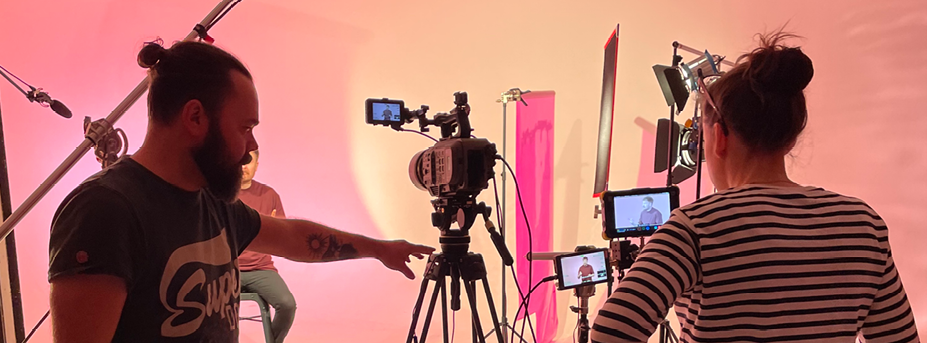
Solution: Dramaski Productions
Organisation: Dramaski
Country of implementation: Sweden
Dramaski is a small public-funded media company based in Stockholm, run by and employing Deaf persons in all roles. The company produces original TV content, translates video/web materials, and develops educational resources all in Swedish Sign Language. The main language is authentic sign language from concept to production, supporting the linguistic development, cultural identity and visibility of children, young people and adults. Dramaski’s model has been replicated by broadcasters in other Scandinavian countries.
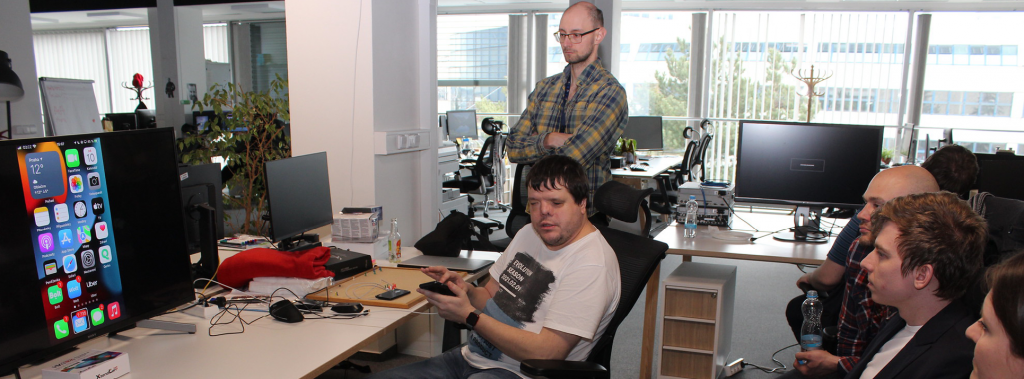
Solution: Théseus
Organisation: Teiresiás Centre, Masaryk University
Country of implementation: Czechia
Théseus was created by the Teiresiás Centre at Masaryk University in Brno which has over 20 years’ experience in accessible education and digital content. The service offers audits, training and resources to improve digital environments for persons with disabilities, combining the lived experience and technical expertise of certified experts with disabilities. Since 2022, Théseus has delivered more than 250 audits for universities, companies and public institutions in Czechia and Slovakia.
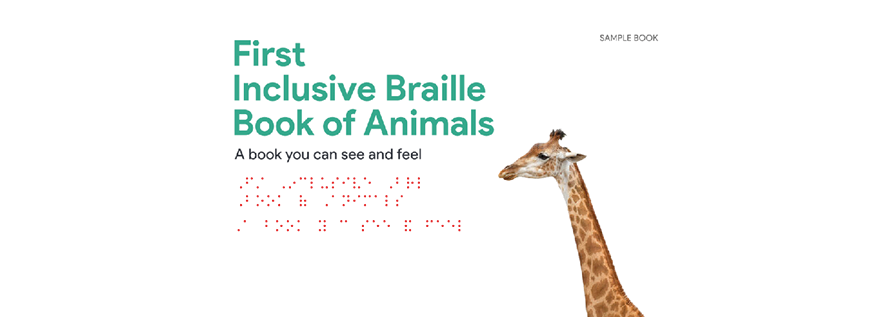
Solution: Inclusive Braille Software
Organisation: Boltay Huroof
Country of implementation: Pakistan
Boltay Huroof is a Pakistan-based NGO founded by local educators and activists to promote literacy and creative expression among underprivileged children in Karachi. Its digital assistive software automates the conversion of printed and digital text into inclusive Braille, allowing individuals with and without visual disabilities to read from the same document.
Read about all of the 2026 awardees.
Connect with Zero Project
 facebook.com/zeroproject.org
 linkedin.com/company/zeroproject
 instagram.com/zeroprojectorg
 youtube.com/user/Zeroprojectorg
Funder: The Essl Foundation is a non-profit family foundation (registered in Austria). Core funding for Zero Project is provided by the family foundation. For specific initiatives, events and programmes, additional funding is provided by a variety of partner organisations. For example, the Zero Project Technology Forum in Vienna is funded with the support of UniCredit Bank Austria, Google, Microsoft, Cisco and The Seneca Trust.
Do you have a question for Judith?
Read about the education provider helping people with disabilities to realise their full potential as equal and active citizens:
www.futurumcareers.com/my-disability-is-part-of-who-i-am-but-it-doesnt-define-me
0 Comments