
Mineral exploration: future-proofing the availability of essential metals
Metals such as copper are not often talked about, but they are essential for many electrical items that we use every day. With the rapid rise in our technology use, these metals are becoming increasingly sought after. Dr James Mungall and Samuel Robb, of Bronzite Exploration, and Karim El Ghawi, a PhD student at Carleton University, in Canada, are exploring unique locations and using remote sensing tools and laboratory techniques to discover potential new copper mining sites, and new ways of deciding which rocks may be useful for copper extraction.
Talk like a geologist
Geology — the study of the Earth, its materials and the processes that shape it
Geophysics — the study of the Earth using physical principles such as gravity, magnetism and seismic waves
Igneous petrology — the study of rocks formed from cooled magma or lava
Inuit — Indigenous People of the Arctic
Magma — molten rock found within or beneath the Earth’s crust
Metal ore — a naturally occurring rock with a significant amount of a metal or metal compound that can be extracted for economic gain
Mineral — a natural solid found in rocks, made of one or more basic substances, with its own shape and colour. Examples include quartz and calcite, and copper minerals such as chalcopyrite, from which copper metal can be extracted
Permafrost — ground that remains frozen for two years or more
Tundra — a large, flat and cold area of land where no trees grow
At some point today, possibly in the last hour, you have probably used a mobile phone. That mobile phone, and the household wiring that allows you to charge it every night, contains copper – a metal mined from rocks. “Everything humanity has is either grown in a field or forest or dug out of the Earth,” says Dr James Mungall of Bronzite Exploration. “The lives and future security of billions of people depend on the fertilisers, metals and minerals that are mined to allow us to eat, shelter ourselves, and reach for future achievements in science, medicine and the arts.”
James and his colleague Samuel Robb are both incredibly enthusiastic about geology and identifying new locations from which to extract metals and minerals. This has led them to start Bronzite Exploration, a mineral exploration company that hunts for new undiscovered mining locations.
Copper in the Canadian Arctic
Metals and minerals are vital for the production of many essential products in our rapidly advancing world, making them highly sought after. “As most of the world moves out of poverty and into relative comfort, our need for materials grows,” says Samuel. “Overall, metal demand is expected to double by 2060, so the competition to find metals is going to be intense. This is a growing industry with huge career potential for decades to come.”
James and Samuel are concentrating on unexplored land within the Canadian Arctic, where there is significant potential for discovering minerals and metals. “Expanding exploration to remote areas will open the door to more economic growth and prosperity for Canadians,” says James. Bronzite Exploration’s leading project, the Somerset Trough Project, is based in Nunavut, which is the northernmost and biggest territory of Canada and contains most of the Canadian Arctic. Here, James and Samuel are investigating signs of copper, zinc and silver mineralisation.
On rare occasions, pure copper can form naturally in rocks. However, most of the world’s copper comes from copper minerals, which contain copper mixed with other elements, such as sulphur. These minerals are processed to extract the pure metal. “Copper is an indispensable metal for any application involving electricity and for applications like household plumbing, roofing and making alloys such as brass,” explains James. “After iron, copper is the most valuable metal commodity. Worldwide use is expected to increase dramatically, while reserves are dwindling fast.”
As a university professor, James is also supervising PhD student Karim El Ghawi who is looking for copper sources from a new perspective. “We need to broaden our view of what can be considered to be a metal ore,” says Karim. “In the future, we can expect to find ourselves increasingly dependent on mining rocks currently regarded as subeconomic or merely as common rock.”
The techniques of mineral exploration
James and Samuel identify possible sites using remote sensing tools, including satellite imagery and airborne geophysical surveys. “These collect detailed information about the Earth’s surface and what lies under the ground,” explains James. “Aircraft fly back and forth over the land, towing instruments through the air to collect data, such as the strength of the magnetic field and the gravitational field, or to detect the presence of electrical conductors under the ground.” In collecting this geophysical data, the team makes images that overlay satellite images and geological field observations, making a detailed map of the subsurface geology.
Protecting a sensitive environment
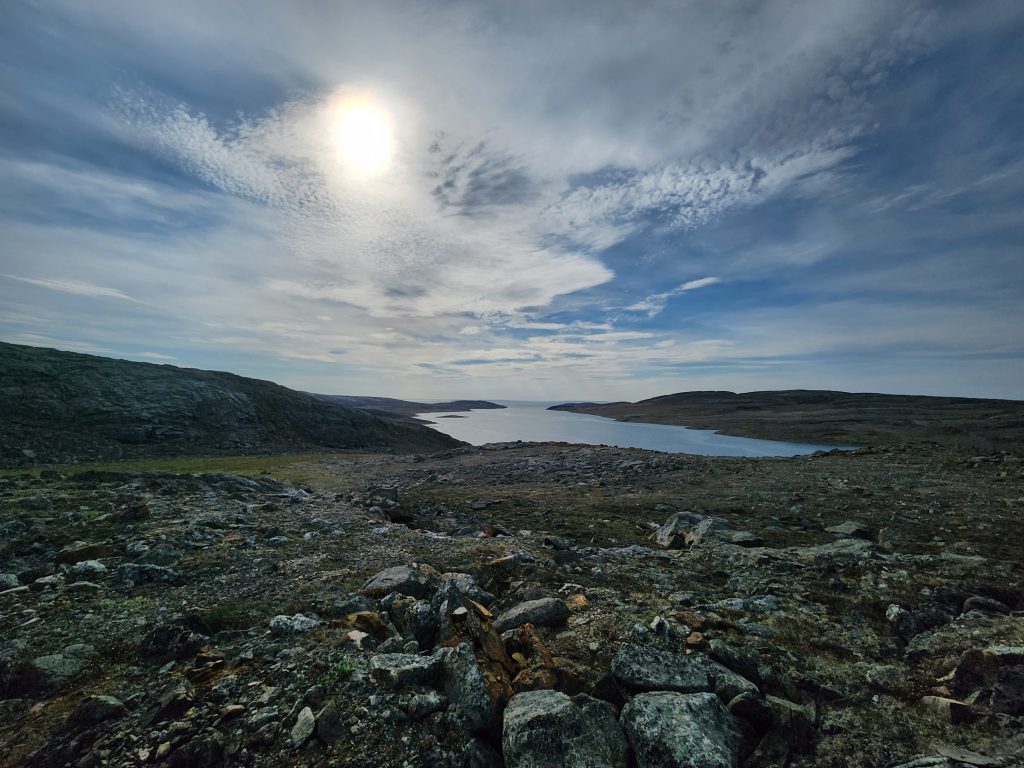
The Canadian Arctic is home to fragile ecosystems including the tundra and permafrost, wildlife such as polar bears, seals and Arctic foxes, and glaciers and freshwater lakes. It is an environmentally sensitive region, where digging can release greenhouse gases, and cold temperatures mean recovery from any environmental damage can last longer than in other areas.
Reference
https://doi.org/10.33424/FUTURUM656

© James Mungall
© Samuel Robb

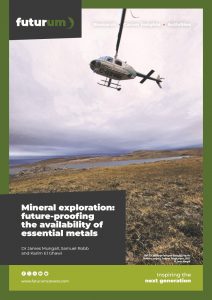
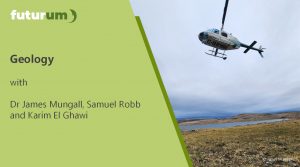
Aerospatiale AS350-B3 helicopter towing Xcalibur HeliTEM magnetometer and bedrock conductivity probe, Somerset Trough project, 2025
© James Mungall

To ensure their work is environmentally sustainable, James and Samuel study requirements for working in the region carefully and submit proposals for their work which are reviewed by experts and through community consultation. “What happens in the field is always dictated by the need to leave as few traces of our passage as possible,” says James. “Water is taken from approved water sources and disposed of responsibly to ensure it doesn’t contaminate the groundwater or surface runoff. All waste is either incinerated or shipped back out, and when we leave a camp, nothing is left behind.”
James and Samuel also respect local communities. “We want local people to benefit from our work and be supportive of what we do,” says James. “We hope to contribute to the growth of new industries and jobs in the north, so that local communities can diversify their economies.” The team thinks carefully about communicating with the community. “We do our best to make sure local communities are informed about the exploration we are conducting,” says Samuel. “We engage through email, phone calls, community visits, Facebook – whatever is best to reach the people we need to reach.”
What are the next steps?
“Our next step is to carefully go through all the data we’ve collated and design the work plan for future years,” says James. “We will continue engaging with local communities, Inuit associations and the territorial government, explaining our aims and taking feedback.” Ultimately, James and Samuel want to drill for samples, make 3D models of the subsurface geology and determine metal concentrations. They will model the economic feasibility of a mining operation and then seek permission to develop a mine.
 Dr James Mungall
Chairman and President, Bronzite Exploration;
Professor, Department of Earth Sciences, Carleton University, Canada
Samuel Robb
Director and Vice President, Bronzite Exploration
Karim El Ghawi
PhD student, Department of Earth Sciences, Carleton University, Canada
Fields of research: Geology; igneous petrology; geophysics
Website: bronziteexploration.com
About geology
Geology is the science of understanding the planet we live on – studying rocks and mountains, volcanoes and earthquakes, and the minerals and metals that are used in phones, cars, buildings and more.
Geologists work to solve real-world problems, such as finding clean water, protecting the environment and building safe cities. “The history of the Earth remains cloaked in mystery and there are innumerable pathways young researchers can follow,” says James. With an increasing urgency for the vast amounts of metals we need for our modern way of living and the technology that permeates that, geology research is becoming increasingly valued.
As well as being important, geology is highly rewarding. “Research in geology is fun and interesting because it combines all of the sciences, and offers opportunities to travel the world,” says James. “In my research career, I’ve worked in laboratories measuring physical and chemical properties of melted rocks, climbed mountains and crossed tundra and forests searching for key rock outcrops, and developed computer models to simulate natural processes in volcanoes and mineral deposits – there is probably no other STEM field that allows one person to do such a variety of things.”
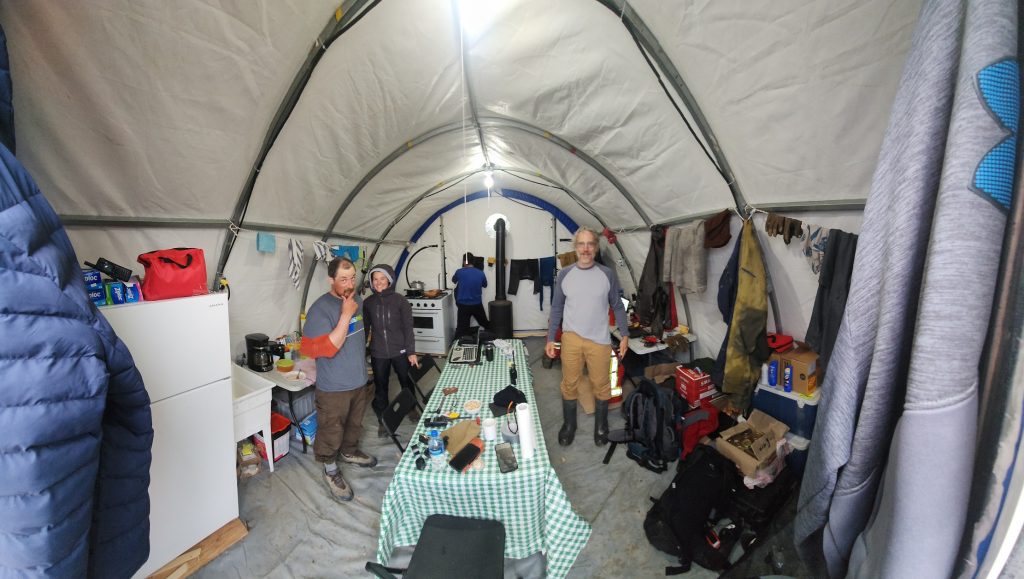
Working in remote locations is fascinating – but it can also be challenging. “The Canadian Arctic land is sensitive to disturbances, so there are no trucks, or roads for that matter, and access requires the use of charter aircraft, helicopters and hiking,” says Samuel. “Supplies, including fuel, are expensive and need to be flown in. We carry all our rock samples in large backpacks after we have been dropped into the area by a helicopter.” During fieldwork, James and Samuel live in tents with diesel stoves for heat, diesel or gas generators for power, and an electric fence to repel wildlife like polar bears and wolves.
Alongside his work at Bronzite Exploration, James is Professor of Earth Sciences at Carleton University. Day to day, he spends his time formulating explanations for observations he has made, testing his ideas (in the lab and in the field), and writing and publishing research papers to share his findings. In addition, he mentors younger colleagues, like Karim. “Taking young geoscientists along on this journey of discovery and publication is especially rewarding,” he says. “Seeing them prosper and build their own careers is always a thrill, especially when I bump into them somewhere else in the world and see what amazing things they have accomplished.”
Meet Samuel
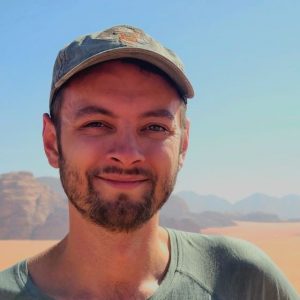 I stumbled into geology while I was trying to figure out what to major in at university. Once I discovered it, I realised it was the perfect combination of science and being able to spend time outdoors in some incredible, remote regions of Canada.
Working in remote regions, from the Arctic tundra in Nunavut, to the mountains in British Columbia, to the Canadian Shield, is amazing. Each time I have gone out into the field, I have learnt something new, made a new discovery, or seen a part of the world I never would have expected to see.
Geology is full of eureka moments. You can spend hours looking at data, making observations in the field and taking measurements, without any idea of what you’re looking at! Then, you get an idea, figure out a way to test it, and everything suddenly fits into place (or it doesn’t, and you go back to the drawing board). It’s all part of the fun and natural process of working in geology.
The biggest challenge of running exploration is managing the uncertainty, whether geological, logistical or financial. Operating in remote areas means every decision matters, with success depending on preparation, adaptability and teamwork. Things often don’t go the way you planned or expected!
The rewards include testing new ideas, being part of new discoveries and mentoring new geologists. Building exploration programmes from the ground up, with input from local communities, is also rewarding. We’ve worked hard to establish Bronzite Exploration as a credible northern explorer, building trust with Inuit organisations, and running safe, efficient field seasons in inhospitable environments – all fulfilling achievements.
My focus is to continue advancing our exploration work at our Somerset Trough Project in Nunavut. I believe we can demonstrate that mineral exploration can be conducted responsibly and provide benefit to local communities.
Samuel’s top tips
1. Stay curious about the things you’re interested in; ask questions and try to figure out the answers on your own. Your curiosity will keep you excited and show your enthusiasm to everyone around you.
2. Be adaptable. In geology and many other fields, technology is transformative and changing the way we work. It’s important to stay on top of new methods and technologies available. That being said, don’t ever lose sight of the field. No matter what technology changes, nothing replaces boots on the ground and spending time with rocks!
3. Find a mentor or mentors who will challenge you to think critically, give you guidance, and push you to learn things on your own.
Meet James
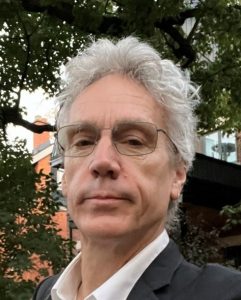 I have always had the desire to spend time in the wilderness, testing my body and my mind against nature. As a child, I often broke open rocks, curious to know what was inside. I also loved literature and enrolled in an English programme but switched to geology because that was where my heart really lay. My first year of studies and fieldwork cemented the choice, and I’ve never regretted the decision.
Eureka moments have often hit when observations haven’t made sense. I’ve poked them in my mind the way you poke a sore tooth and then, suddenly, something has clicked. For example, I was mapping rocks in northern Quebec, and nothing was making sense in terms of where nickel mineralisation was being found – we had assumed it was only in lava flows, but this didn’t match the data. One day, I realised the mineralised bodies were all part of one huge intrusive magmatic rock formation called a dike that cut across all the other rocks on the map. This gave us a tool to predict where the next discovery could be made. Once you step back and look at the whole picture, you wonder why it took you so long to understand!
Achievements that make me feel my time is well spent include: publishing papers that have changed how people think about scientific processes; making geological maps that have become go-to sources of knowledge about regions of northern Canada; and building an exploration company with Samuel that, in just three years, has become one of the most ambitiously funded exploration programmes in the country.
Lately, I’m very proud of the work I’m doing to create a fully online master’s programme in mineral exploration and resource management. This programme will pull together my lifetime experience of working and teaching to give early career geoscientists a unique geoscience and business degree.
Although I’m approaching retirement age, I have no desire to stop being productive. Over the coming years, I hope to see our Somerset Trough Project selected by a major mining company for development. After we launch the master’s programme, I look forward to seeing our graduates spreading out around the world and achieving success in exploration. On the research front, I plan to publish a paper re-evaluating the composition of the Earth’s upper mantle. And, of course, I’m eager to see what Karim’s work on unconventional resources will show us about our future as a metal-producing country.
James’s top tips
Pour yourself into your work, doing it for the love of accomplishing something. Always give a little more than you were asked for and seek to constantly learn about subjects that might seem a little scary. As American physicist Richard Feynman said, when a new subject seems too complicated to understand, don’t turn away from it – that is the moment when it starts to get exciting!
Q & A
Meet Karim
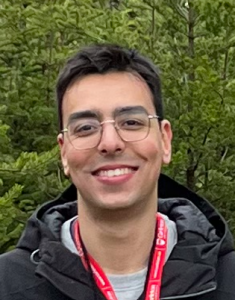 Karim El Ghawi, PhD student, Department of Earth Sciences, Carleton University, Canada
Fields of research: Geology; geometallurgy
Funder: Natural Sciences and Engineering Research Council of Canada (NSERC)
Glossary
Geometallurgy — the study of rocks to discover how useful metals can be found, extracted and processed from them
Leaching — a process where minerals are dissolved and removed from rock
Magnetic separation — a process using magnets to separate magnetic and non-magnetic materials
Ore — a rock containing a valuable mineral
Who or what motivated you to pursue geology?
I began my undergraduate studies in chemistry at the American University of Beirut in my home country, Lebanon. As part of this programme, I took a geology course that introduced me to the key minerals in rocks. I quickly became fascinated and decided to pursue a minor in geology. With encouragement from my professor, I chose to complete a full degree in geology, knowing I wanted to continue into research in the field. This led me to move to Canada where I completed my master’s at Carleton University, and I am now pursuing my PhD in geology.
What did you study for your master’s degree?
I focused my master’s research on the Tamarack Intrusive Complex, a large underground rock formation in Minnesota in the US, because it is rich in essential metals like nickel, copper, platinum and palladium. These metals are critical for technologies such as batteries, electric cars, renewable energy and medical devices. Tamarack is especially important because it shows how magma carrying these metals interacted with surrounding rocks deep underground, concentrating them into ore deposits.
How did you use computer modelling for this research?
Computer modelling helps recreate conditions deep inside the Earth, such as temperature, pressure, and chemical reactions, without going there physically. Using software, we can predict how magma cools, minerals crystallise, and metals become concentrated into ores. In my master’s research, I used models to test scenarios of how magma interacted with surrounding rocks or other magmas. This revealed which processes were most important for trapping valuable metals and forming ore deposits.
What were your key findings?
I studied how metal-rich sulphide minerals formed and found that different sulphide-mineral rock textures reflect how magma cooled and crystallised. Using computer models, I showed that even small amounts of surrounding rock or gases could trigger sulphide deposit formation, concentrating metals like nickel, copper, platinum and palladium. I also discovered that the unusual platinum and palladium enrichments were caused by magmatic processes – the movements and changes of magma as it forms, moves and cools – not by later, hot fluid activity.
How did your master’s lead to your current PhD study?
My master’s research prepared me for my PhD by strengthening my research skills and sparking my interest in where our metals come from. I learnt to design computer models and analyse mineral data, which gave me the confidence to take on a larger project.
What are you investigating for your PhD?
I am investigating metals in rocks that are usually not considered to be ‘ore’, which is rock that contains enough metal to make mining worthwhile. All rocks contain small amounts of valuable metals, but not enough to be mined with today’s methods, which is why, when we consider how we could extract metals from them, they are called unconventional resources. They have potential because they are widespread and abundant. As demand for critical metals grows, these common rocks could one day become important, new sources of supply.
What research methods are you using?
I plan to use modern geometallurgical methods to study how metals are locked in rocks and how they can be extracted. This involves collecting rock samples, using imaging techniques like X-ray mapping using an electron microscope to see which minerals contain certain metals, and running lab tests like magnetic separation or leaching to see how easily the metals can be released. These methods help predict which unconventional rocks could become future sources of critical metals.
What are the next steps for your PhD?
I plan to collect rocks that represent many of the main rock types that make up Earth’s crust. By studying these, I will be able to compare how important metals are distributed in different rock types and under different conditions – my aim is to come up with general rules that will allow us to predict the sites in any rock where metals are concentrated. The next steps will be detailed lab and computer analyses to understand how these metals could be extracted in the future.
How do you switch off from the pressures of studying?
Doing a PhD can be challenging at times, so I try make sure to balance my research with activities that help me recharge. Playing sports, especially soccer, is one of my main ways to switch off. It keeps me active and lets me focus on something completely different from my studies. Spending time with friends also helps me relax and stay connected outside of the academic world.
What are your proudest career achievements so far?
Presenting my research at several scientific conferences. These events bring together top academics and experts in this field from around the world, so they are great opportunities to share my work, have discussions, and receive feedback.
What are your goals for the future?
Looking ahead, my main goal is to complete my PhD and make a meaningful contribution to how we think about future metal resources. I am most excited about uncovering how valuable metals are stored in common rocks that have not been studied in detail before. By understanding this better, I hope my research can help guide new, sustainable ways of supplying the metals needed for technologies such as renewable energy. Ultimately, I want my work to play a role in supporting the transition to a greener, more sustainable future.
Karim’s top tips
1. Stay curious and spend time exploring the world around you. Geology is all about asking questions: Why does this rock look this way? How did this landscape form?
2. Don’t be afraid of the science; geology combines chemistry, physics and biology in exciting ways.
3. Most importantly, get outside when you can. The best lessons in geology happen in the field, not inside the classroom.
Pathway from school to geology
Developing skills in maths and science at school, especially in calculus, algebra, chemistry, physics and biology, will help build a solid foundation for geology.
Develop your written and verbal communication skills as these will help with report-writing and presenting.
At university, study Earth sciences or geology, or specialise in environmental geoscience or geophysics if you can.
“If you want to work as a geoscientist after you graduate, you will have to qualify for professional status in the same way as engineers do,” says James. “This involves completing a four-year programme, followed by four years of work experience under the supervision of a professional geoscientist. You must then pass an examination of your ability to perform ethically and in compliance with the laws.”
“Building leadership skills can be important, so look for opportunities in sports or other extracurricular activities,” says Samuel. “Volunteering in the community can help build valuable leadership and people skills.”
Explore careers in geology
Learn more about the work of James and his colleagues in the Department of Earth Sciences at Carleton University.
The Geoscientists Canada website offers advice and information about careers in geoscience. It also provides links to local professional organisations in Canada which you could join and attend events through.
Explore the website of the Mining Association of Canada which shares useful information about the mining industry and is a popular employer of geoscience graduates in Canada.
The websites of the European Geosciences Union and the Geological Society of America both contain a wealth of information about careers, the latest research and conferences networking events. You could even consider becoming a student member.
Do you have a question for the team?
Write it in the comments box below and they will get back to you. (Remember, researchers are very busy people, so you may have to wait a few days.)
How are researchers predicting rockfalls?
futurumcareers.com/can-we-predict-where-falling-rocks-will-go
0 Comments