
How are computer scientists combatting food fraud?
Food fraud is a growing concern, with low-quality products deliberately mislabelled and fraudulently sold as high-quality products. In Italy, a team of computer scientists, including Professor Remo Pareschi from the University of Molise, has developed a digital platform to provide traceability in food supply chains, helping to combat food fraud and improve food safety.
Talk like a computer scientist
Black box – a system in which an observer cannot tell how outputs from a model were derived from inputs
Blockchain – a method to ensure that digital data cannot be altered
Cryptographic fingerprint – a digital code that uniquely identifies a piece of data
Extra virgin olive oil – pure juice from pressed olives that has not been chemically treated or mixed with other batches of oil
Provenance – place of origin
If you buy a bottle of Italian extra virgin olive oil, there is a significant risk that the liquid inside is not what it claims to be on the label. “Extra virgin olive oil is one of the most counterfeited food products in the world,” says Professor Remo Pareschi, a computer scientist at the University of Molise.
You might wonder why, as a computer scientist, Remo is interested in mislabelled olive oil. Well, he and his colleagues are using their computer science skills to develop a digital platform that provides traceability in food supply chains, helping to combat food fraud and improve food safety.
Why do we need traceability in food supply chains?
“Think about what happens between a farm and your plate,” says Remo. “Food is grown by a farmer, analysed by a laboratory, packaged by a company, checked by a certification body, shipped by a distributor and finally sold by a supermarket.” Each stage in this process produces information, such as soil measurements, chemical analyses of food samples and quality control certificates.
Historically, this information is stored in separate systems that do not interact with each other, making it hard to trace individual items through the supply chain. If there is a contamination outbreak, for example, it is difficult to reconstruct what happened. And consumers cannot check whether the product they are buying is really what it says on the label. Is the olive oil really Italian extra virgin? Are the eggs really free range?
Developing a traceability platform
To address this, a network of Italian institutions has developed METROFOOD-IT. This project brings together universities, research centres and laboratories across Italy, combining physical research facilities (where food samples are analysed) with the platform that Remo and his colleagues have built. “METROFOOD-IT tackles information fragmentation by building a single digital infrastructure that connects laboratories, producers, certification bodies and consumers, so that data generated at any point in the food supply chain can be stored, verified and analysed in a coordinated way,” says Remo.
Reference
https://doi.org/10.33424/FUTURUM698
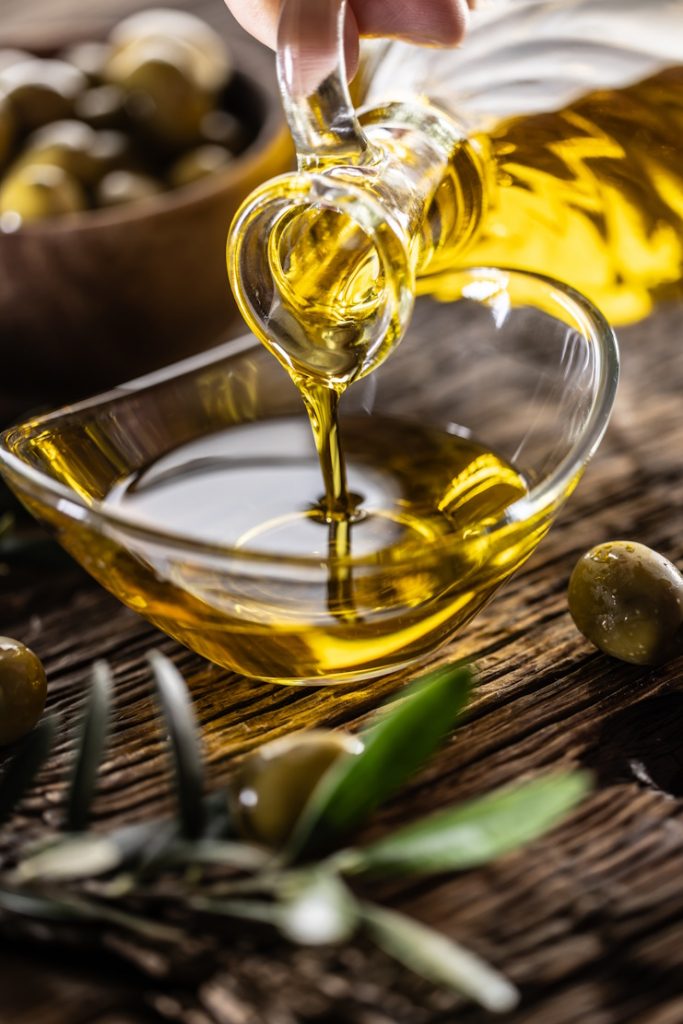
Extra virgin olive oil is one of the most counterfeited food products in the world, so Remo has developed a digital platform to help prevent food fraud.
© Marian Weyo/Shutterstock.com
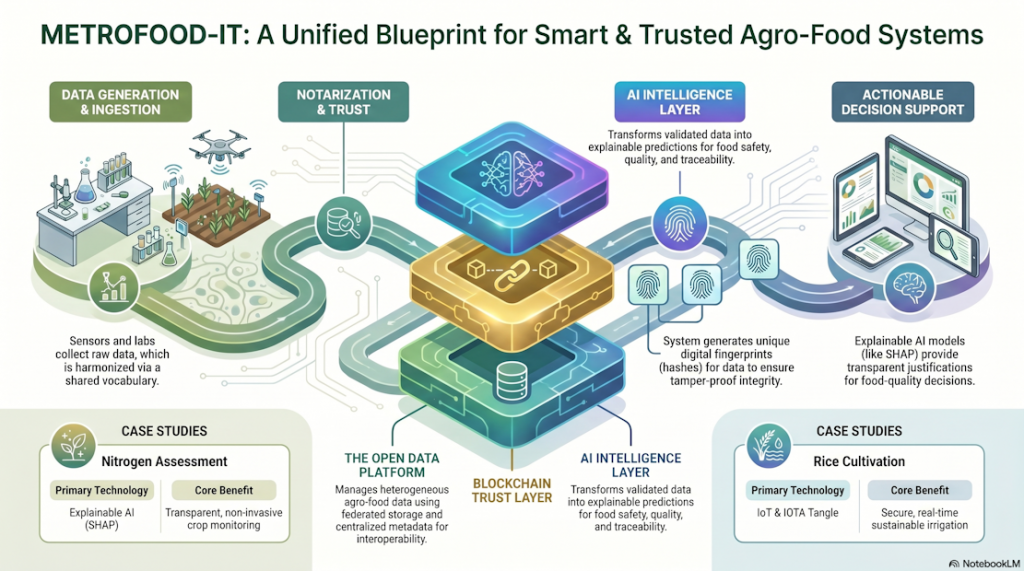

METROFOOD-IT consists of three components – an open data platform, a blockchain layer and an AI layer – that work together as a single pipeline. The open data platform stores all data generated throughout the food supply chain, from soil moisture measurements and satellite images of crop health on farms, to food nutrient levels and bacterial analyses in processing plants, to certification documents stating exactly where and when an item moved through the production line.
Verifying data with blockchain
A blockchain is a digital ledger stored across many computers in a network. Once data is written into a blockchain, no one can change or erase it. The blockchain layer in METROFOOD-IT ensures that data on the platform is authentic and has not been tampered with.
“In METROFOOD-IT, we use blockchain in a clever way,” says Remo. “We don’t put the full datasets on the blockchain as that would be too expensive and slow. Instead, we register a cryptographic ‘fingerprint’ of each data file that is calculated from the file’s content. If someone altered even a single comma in the original data file, it would produce a completely different fingerprint.”
The blockchain layer means that if someone wants to verify that a lab report or provenance certificate has not been tampered with, they can recompute the data’s cryptographic fingerprint and compare it to the one stored on the blockchain. If they match, the data is authentic. “This is important because food safety depends on trust,” says Remo. “And trust depends on the ability to prove that data hasn’t been altered along the way.”
Analysing data with AI
Once data has been stored in the METROFOOD-IT open data platform, it is verified through the blockchain layer. After this, the AI layer generates useful insights from the data. Some advanced AI models use a ‘black box’ process – they give answers without explaining how or why they have reached those conclusions. “That’s not good enough for food safety regulations, because a certifier or policymaker needs to understand why the model is making a particular decision,” says Remo. So in METROFOOD-IT, the AI layer uses techniques that open the black box to show which parts of the data most influence each prediction. “The outputs of the platform aren’t just numbers,” says Remo. “They’re explained recommendations that producers, certifiers and regulators can trust and rely on.”
Tracing olive oil production
With so many cases of low-quality olive oil being fraudulently sold as extra virgin, olive oil production is a great example of how METROFOOD-IT works. The open data platform stores information from every step of the process, including soil analyses from the olive grove, the date and conditions of the harvest, chemical analyses performed at the oil press, and bottling and packaging records. Each piece of data gets its own cryptographic fingerprint registered on the blockchain, so no one can later alter a certificate or swap in cheaper oil and claim it is the original. The AI layer combines the data to confirm the oil’s provenance and detect potential fraud. “Everyone in the chain benefits,” says Remo. “Producers can prove the authenticity of their product, sellers gain confidence in what they’re distributing, and consumers can scan a QR code on the bottle to check that the oil they’re about to buy is what the label claims it to be.”
Thanks to the work of the computer scientists behind METROFOOD-IT, food supply chains are becoming safer and more trustworthy – and the next generation of computer scientists will help take this work further.
 Professor Remo Pareschi
Stake Lab, University of Molise, Italy
Field of research: Computer science
Research project: Developing a digital platform to provide traceability in food supply chains
Institutions: ENEA; National Metrology Institute of Italy; Universities of Bari, Naples Federico II, Parma, Rome Sapienza, Siena and Molise
Funder: Italian National Recovery and Resilience Plan supported by the European Union
Website: metrofood.it
Do you have a question for Remo?
Write it in the comments box below and he will get back to you. (Remember, researchers are very busy people, so you may have to wait a few days.)

Discover how Remo has developed a new and more effective AI framework:
futurumcareers.com/building-better-ai-how-are-computer-scientists-improving-ai-systems
0 Comments