
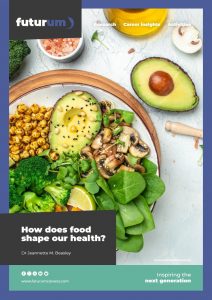
How does food shape our health?
A good diet is essential to our well-being, and the importance of a healthy diet only increases as we get older. While healthy diets help to keep us free from disease, diets lacking key nutrients can contribute to conditions such as heart disease and diabetes. That is why Dr Jeannette Beasley from New York University in the US is researching how we can improve our diets to keep diseases at bay, especially as we approach old age.
Talk like a dietitian and nutrition epidemiologist
Biomarker – a measurable substance in an organism that indicates the level of exposure to a substance or presence of a disease
Cardiovascular – relating to the heart and blood vessels
Chronic disease – long-lasting health conditions that require ongoing medical attention and/or limit daily activities
Cognitive – relating to the mental processes involved in gaining knowledge and understanding
Holistic – dealing with problems by looking at the whole situation, rather than at each individual part
Metabolic – relating to the chemical processes within an organism that produce energy and maintain life
Type 2 diabetes – a chronic metabolic disorder characterised by high blood sugar resulting from the body’s inability to use insulin properly
The food that we eat provides the molecules that make up every part of our body. “Nutrients such as protein, fibre, healthy fats, vitamins and minerals help regulate energy, support immune function, maintain muscle, and protect heart and brain health,” says Dr Jeannette Beasley from New York University. When these systems go wrong, diseases emerge. And the longer we live, the more vulnerabilities these systems accumulate. “Over time, our dietary patterns can either reduce or increase our risk of chronic disease,” says Jeannette. “I study how improving diet quality can help people not just live longer, but better.”
Jeannette is involved in a number of projects, studying and communicating what constitutes a healthy diet – in particular, for older adults who are more likely to face health problems. A healthy diet is not just about avoiding unhealthy foods, but also about ensuring that the foods we do eat have the optimal levels of nutrients that our body needs.
Diet and disease
Many chronic diseases are caused by a mixture of factors relating to a person’s genes, environment and lifestyle. For instance, risk factors for the development of type 2 diabetes include obesity, physical inactivity, genetics, age and diet. “Diets high in added sugars and salt increase the risk of diabetes,” says Jeannette. High intake of these molecules makes the pancreas release excessive quantities of the hormone insulin to manage blood sugar spikes. If this process is repeated for a long time, the body simply stops being receptive to insulin, leading to an inability to manage blood sugar levels effectively. But while some foods heighten these risks, other foods do the opposite. “Diets rich in fruits, vegetables, whole grains, and beans can lower risk,” explains Jeannette. “Not just for diabetes, but for a whole range of chronic diseases.”
As we get older, certain aspects of our diet require more careful attention. “My research indicates that higher protein intake is associated with better physical mobility and lower frailty among older adults,” says Jeannette. “As we age, maintaining muscle mass becomes critical for independence.” Chronic diseases, including diabetes and heart disease, become more likely in older age. “Maintaining a diet that is rich in fibre and potassium and lower in salt plays a role in maintaining cardiovascular health into old age,” continues Jeannette.
A BRIDGE for older adults
Given that diseases like diabetes are affected by many lifestyle factors, it is important to have holistic programmes in place to prevent these diseases from developing. “The US National Diabetes Prevention Program is focused on helping high-risk individuals improve diet and physical activity through lifestyle intervention,” says Jeannette. “Research indicates that participation in this programme can reduce diabetes risk by nearly 60 percent.”
Jeannette felt that the already effective programme could be improved by accommodating the specific needs of older adults. This is why she developed a project called BRIDGE: BRInging the Diabetes prevention program to GEriatric populations. “To make the programme more accessible for older adults, we adjusted materials to account for hearing and vision loss, focused on building social support, and made age-appropriate recommendations for physical activity,” she says. “We also included dietary recommendations from sources such as the US National Institute of Aging.” Age-related issues, such as lower muscle mass or bone density, were acknowledged and incorporated into the programme. Jeannette’s research indicated that this specially tailored programme boosts engagement and participation of older adults.
Using data to inform dietetic practice
Reference
https://doi.org/10.33424/FUTURUM688
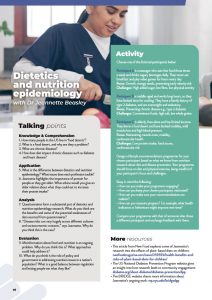





Jeannette’s research, including BRIDGE, is founded on a strong evidence base. Dietitians and nutrition epidemiologists, like Jeannette, use a range of tools and analytical skills to help them study how diet influences health across populations. “We use a range of questionnaires that ask participants which types of food they typically consume, or what they consumed in a set time period, such as the last 24 hours,” explains Jeannette. “We also use objective biomarkers, such as measuring nitrogen concentration in urine samples, to improve measurement accuracy.” Advanced statistical techniques and different types of trials help generate a range of high-quality comparable data.
Digital technologies are making data collection and processing easier than ever. “Electronic health records allow us to study real-world patient outcomes across large populations,” says Jeannette. “They provide data on diagnoses, laboratory values and long-term health outcomes.” It is important to include demographically diverse populations in these studies because disease risks can vary hugely across different cultures and socioeconomic contexts. “Inclusive research ensures recommendations are equitable,” says Jeannette.
Jeannette’s latest projects are embracing these technologies and ensuring inclusivity. “I am collaborating on projects that are exploring digital and AI-supported interventions, while continuing to improve our understanding of the role of dietary patterns in cardiovascular, metabolic and cognitive health,” she says. “My long-term goal is to improve diet quality among older adults while increasing equity and inclusion in nutrition research.”
 Professor Jeannette Beasley
Associate Professor, Department of Nutrition and Food Studies, Department of Medicine, New York University, USA
Fields of research: Dietetics; nutrition epidemiology
Research project: Exploring the links between diet and disease
Funders: New York University; US National Institutes of Health; Centers for Disease Control and Prevention; American Diabetes Association; Institute for the Advancement of Food and Nutrition Sciences; American Heart Association
About dietetics and nutrition epidemiology
Dietetics is the study of diet and its effect on health and nutrition. “Dietetics combines biology, behaviour, medicine and public health,” says Jeannette. “It offers opportunities to conduct research, work clinically, influence policy and educate communities.”
Nutrition epidemiology focuses on how diet affects health across populations. Researchers analyse dietary patterns, health data and biomarkers to understand how food influences diseases like diabetes and heart disease, and to identify ways to prevent them.
A day in the life of a dietitian or nutrition epidemiologist is typically very varied. “My days include mentoring students and junior faculty, teaching, analysing data, reading and contributing to papers, writing grants, and collaborating with clinicians and community partners,” says Jeannette. “No two days are the same, which makes the field dynamic and rewarding.”
Everyone eats, so dietetics affects us all. “Nutrition affects nearly every chronic disease, so the potential for impact is enormous,” says Jeannette. Dietetics also engages with the socioeconomic side of nutrition, acknowledging the health disparities that arise due to differences in ability to access nutritious food. For instance, around 19 million people in the US live in ‘food deserts’ (areas far away from the nearest supermarket) meaning they may rely on processed foods found in smaller stores or fast-food outlets close by. Addressing these challenges involves a lot of advocacy and communication work.
The importance of effective communication is also exemplified in countering myths about nutrition. Public opinion on which foods are healthy or not is changing all the time, and is not always based on evidence. “Combatting misinformation and finding ways to make accurate measurements to better understand the science are big challenges in our line of work,” says Jeannette. “To meet these challenges, it’s important to have strong communication and critical thinking skills.”
Pathway from school to dietetics and nutrition epidemiology
At school, subjects such as biology, chemistry, mathematics (especially statistics) and psychology are useful for understanding the core material around dietetics and nutrition.
At university or college, the same subjects can lead to a career in dietetics – as can fields such as food science, clinical nutrition, public health or human physiology. A dietetic internship and registration exam are also necessary milestones for becoming a registered dietitian in the US.
Jeannette also recommends getting research or volunteer experience in healthcare or in community settings to understand more about dietetics as a career path and what it looks like in practice.
Explore careers in dietetics and nutrition epidemiology
Jeannette recommends exploring professional organisations such as the American Heart Association, where she serves on the nutrition committee.
Careers in dietetics may fall under job titles such as clinical dietitian, public health nutritionist, research scientist, professor, policy advisor or digital health innovator. You can find out more about the path to become a Registered Dietitian Nutritionist here.
As Jeannette mentions, dietetics careers (and salaries) are very varied. Dietitians can work in hospitals, private practice, health departments or academic research, like Jeannette.
Meet Jeannette
When I was five, I chose to become a vegetarian for ethical reasons. In high school, my biology teacher questioned whether I would get enough protein to grow. This sparked my interest in nutrition science and eventually shaped my career.
I love discovering new insights about diet. I enjoy uncovering how diet influences long-term health, which unlocks the possibility of preventing chronic disease and helping people age with strength and independence. I also love mentoring the next generation of researchers and seeing them grow into professionals.
Curiosity and persistence are essential ‘soft skills’ in dietetics. Additionally, strong quantitative analysis skills are very handy, as is a focus on establishing and nurturing strong mentor relationships.
I have run five marathons across the United States, Italy and Ireland! Staying active is important to me: I love running, yoga and keeping up with my son, which keeps me balanced and energised. Seeing his curiosity and hearing his constant questions about science and health reminds me why science communication and mentorship matter.
Jeannette’s top tips
Ask questions, embrace statistics, stay active and do not let doubt discourage you. Curiosity can turn into a lifelong career.
Do you have a question for Jeannette?
Write it in the comments box below and she will get back to you. (Remember, researchers are very busy people, so you may have to wait a few days.)
Learn more about how dietetics can help teenage athletes perform better:
futurumcareers.com/staying-on-track-how-do-teenage-athletes-choose-what-to-eat
0 Comments