
Classroom resources for the new school year
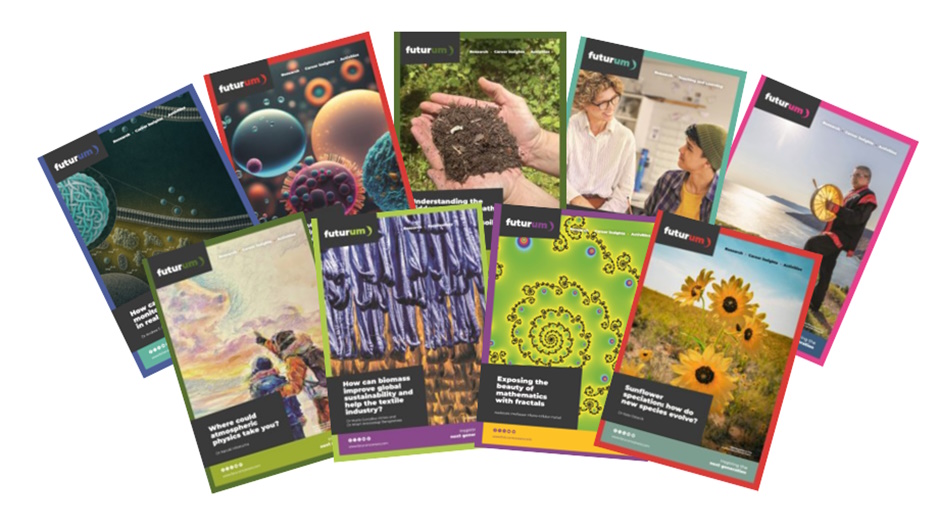
Do you need free and engaging educational resources to use in your classroom?
We’ve got you covered!
As the new school year gets up and running, why not explore our free educational resources and share them with your students? At Futurum, we work with researchers and academics from all disciplines to create classroom resources. Each article explains the researcher’s work and provides advice for students interested in pursuing a career in their field. Our articles are accompanied by activity sheets which contain talking points to encourage students to discuss, analyse and evaluate the research project, along with practical, hands-on activities that can be done in the classroom or set as homework. Some resources also include animations, podcasts and PowerPoints.
Whether you teach maths, biology, history, music or anything else, we’ve got resources for you! Here is a selection of our subject-specific resources published over the past year:
Maths
Statistics – Dr Catia Scricciolo is developing statistical methods to counteract the problem of noise in scientific data. Show your students how maths can be used to support real life science projects.
Applied mathematics – Professor Jeff Anderson is developing an open-access learning curriculum to create rich applied learning experiences for his students. His article discusses all of the different careers available to those who study maths!
Mathematical modelling – Professor Mark Boyce is modelling wildlife populations to help inform management decisions. His article shows how maths can be used to help solve some of our most pressing issues.
The beauty of maths – Assistant Professor Pierre-Olivier Parisé has developed a method to visually render fractal objects, showcasing the beauty of these intriguing patterns. Inspire your students by showing them maths like they’ve never seen it before!
English
Comprehension – All our articles can be used for comprehension reading exercises. Each article is accompanied by an activity sheet that contains talking points to encourage students to reflect on what they have read.
Publishing – Dr John Maxwell and Alessandra Bordini are studying, archiving and sharing the work of Aldus Manutius, a renaissance scholar and printer who revolutionised book design and publishing.
Science fiction – After learning about Dr Andrea Alamia’s work in neuroscience, students are encouraged to write a science fiction short story that explores his research.
Biology
Evolution – Dr Kate Ostevik is investigating the process of speciation using sunflowers. Why not use this real-world example to teach your students about evolution?
Immune system – Dr Steven Kerfoot is studying the interactions between B cells and T cells in the immune system and exploring how malfunctions can lead to the development of autoimmune diseases.
Ecology – Dr Camilla Filgueiras and her students have been developing new technologies to shine a light on the hidden world of soil ecology. Show your students how they can get involved in real-world research!
Molecular biology – Professor Patricia Kane is investigating how V-ATPase dysfunction may lead to neurodegenerative disease. Encourage your students to use their biology skills to make a difference in the world!
Chemistry
Biomaterials – Dr Andrea Carlini and her research team are designing structurally-responsive polymer probes to help doctors track and treat diseases. She also encourages students to join chemistry clubs to gain hands-on experience.
Direct air capture – At the RECARB hub at Monash University, researchers are looking for innovative ways to recycle and reuse carbon. Show your students how chemistry can help solve one of the world’s biggest challenges!
Chemical engineering – How can chemistry help make the textile industry more sustainable? Explore the research of Dr María González Alriols and Dr Mirari Antxustegi Bengoetxea to find out!
Physics
Nuclear fusion – Dr Kurt F Schoenberg is a nuclear physicist who believes that nuclear fusion will become viable within the next few decades. Do your students agree?
Atmospheric physics – As an atmospheric physicist, Dr Naruki Hiranuma hopes to improve our understanding of atmospheric ice and cloud formation and refine the physics theories that explain how clouds and precipitation form.
Engineering – Benedict Späth is designing new batteries to help the transition from fossil fuels to renewable energy. Show your students how physics can be used to solve problems.
Geography
Geology – Dr James Mungall and his team are using remote sensing tools and laboratory techniques to discover potential new copper mining sites, and developing new ways of deciding which rocks may be useful for copper extraction.
Geotechnical engineering – How can we predict where falling rocks will end up, and why should we care? Professor Nick Hudyma and his team are conducting geotechnical experiments to better predict rockfalls.
Natural disasters – Dr Christin Salley is investigating how community resilience can support disaster preparation and response. Investigate what happens when human and physical geography come face to face.
Oceanography – Dr Juliana Marson uses mathematical models to understand ocean currents and track icebergs. Show your students how geography can help them travel the world!
History
Archaeology – Professor Karl Knappett leads a team of archaeologists who are piecing together ancient Greek pottery fragments. Your students will discover how archaeologists learn about ancient societies through artefacts.
Changing cultural attitudes – How have opinions about feminism changed throughout history and around the world? Dr Maha F. Habib explores the writings of two Egyptian women to examine how colonialism shaped their countries attitudes towards women.
The history of science – Dr Matteo Sporanzo analyses medieval manuscripts to investigate how culture shaped scientific ideas and priorities. What can your students learn from his historical research?
Modern Languages
Comprehension – Many of our research articles and activity sheet have been translated into other languages, including Spanish, French, German, Portuguese, Swahili, Mandarin and Arabic. This makes them ideal resources for language lessons and means they are accessible for speakers of other languages.
Art
Arts-based knowledge mobilisation – Professor Elaine Power and the Hungry Stories team use art to share stories about food insecurity. Ask your students how they would use art to create change.
Sculpture – After learning about Dr Chinyere Knight’s research in mycology, challenge your students to create a 3D model of a slime mould!
Graphic novels – After learning about Dr Ariangela Kozik’s research in microbiology, encourage your students to create a graphic novel based on what they’ve learnt.
Textiles – Dr Karin Högberg and Nils Lindh have designed an innovative new sanitary pad designed to be durable, hygienic and easy to clean, providing dignity for women and girls who desperately need it.
Citizenship
Youth empowerment – The YES programme supports and empowers young people through community engagement. Inspire your students to engage with local community groups and make change.
Sociology – Dr Michelle Maroto is one of the researchers leading the Great Canadian Class Study, a large-scale project using surveys, interviews and other tools to understand the links between economic, social and cultural factors within Canada’s diverse population.
Economics – Do your students have dreams of owning their own homes? Professor Rachel Ong Viforj is a housing economist who informs and advises policymakers with the hope of helping young people buy their first homes.
Computer Science and Technology
Artificial intelligence – AI is everywhere and, for better or worse, it is here to stay. In this resource, researchers from the London School of Economics discuss issues surrounding artificial intelligence and its effects on society.
Software engineering – Dr Masud Rahman is investigating how artificial intelligence is changing how software engineers fix bugs. His article is full of extra resources for your students to explore.
Robotics – Dr Hao Zhang is exploring how robot teams can become more resilient, intelligent and cooperative by learning from human teamwork. Inspire your students to follow their dreams and design their own robots!
Music
Ethnomusicology – Music is a central part of almost all human communities. Professor Marcia Ostashewski founded the Centre for Sound Communities to explore the stories that connect people to their music, their communities and their identities.
Music education – COVID-19 is likely to have affected your students lives in many ways, including how they engage with music. Dr Ardelle Ries is investigating how the pandemic affected children’s attitudes to singing, and what this means for their development.
Bioacoustics – How can music feed in to other subjects that your students study? Dr Lucille Chapuis studies how fish communicate using sound, and how they are affects by human-made noise.
Physical Education
Nutrition – How does nutrition affect the performance of student athletes? Dr Tamara Cohen and her student Alysha Deslippe have developed an app that could help your students make better decisions about what to eat.
Recreation and leisure – Professor Heather Mair is studying the social role of curling clubs and exploring the impact of curling on well-being. Challenge your students to investigate the impact of extra-curricular activities at your school.
Teacher CPD
Two-eyed seeing – In many classrooms, STEAM subjects are primarily taught through Western or mainstream scientific approaches. That’s why IndigeSTEAM Society is supporting teachers in adopting Two-Eyed Seeing – a framework that brings together Indigenous/traditional and Western/mainstream ways of knowing to create more meaningful, culturally-responsive learning experiences.
Metacognition – Led by Professor Mariëtte van Loon, a research team in Switzerland is investigating how metacognition affects a student’s ability to learn. Discover how you can adapt your teaching style to better support this vital cognitive faculty.
Need more inspiration?
If you want more classroom activities for different subjects, check out these ideas from last year: https://futurumcareers.com/classroom-resources-for-the-new-school-year-4
0 Comments